Your reusable working recordAnnotated completed recordDownload the printable pack
Version 2 · Revised 11 November 2026 · 4/12
Listen Carefully and Ask Better Follow-Up Questions
Conduct a short inquiry conversation that follows the speaker’s meaning and checks interpretation.
Bring to the taskA low-stakes topic, a willing partner and a clear purpose for the conversation.
A colleague says, “I cannot get proposals out on time.” The listener immediately asks, “Have you tried planning your week?” Advice has arrived before the difficulty is understood. The colleague may already plan carefully; the missing input might come from someone else. A useful follow-up begins with the answer you have just heard.
Listening is observable work. You can allow a person to finish, identify an ambiguous term, refer accurately to a detail, summarize the meaning and invite correction. Silence alone is not proof of understanding, and asking a long list of questions can feel like processing a form rather than having a conversation.
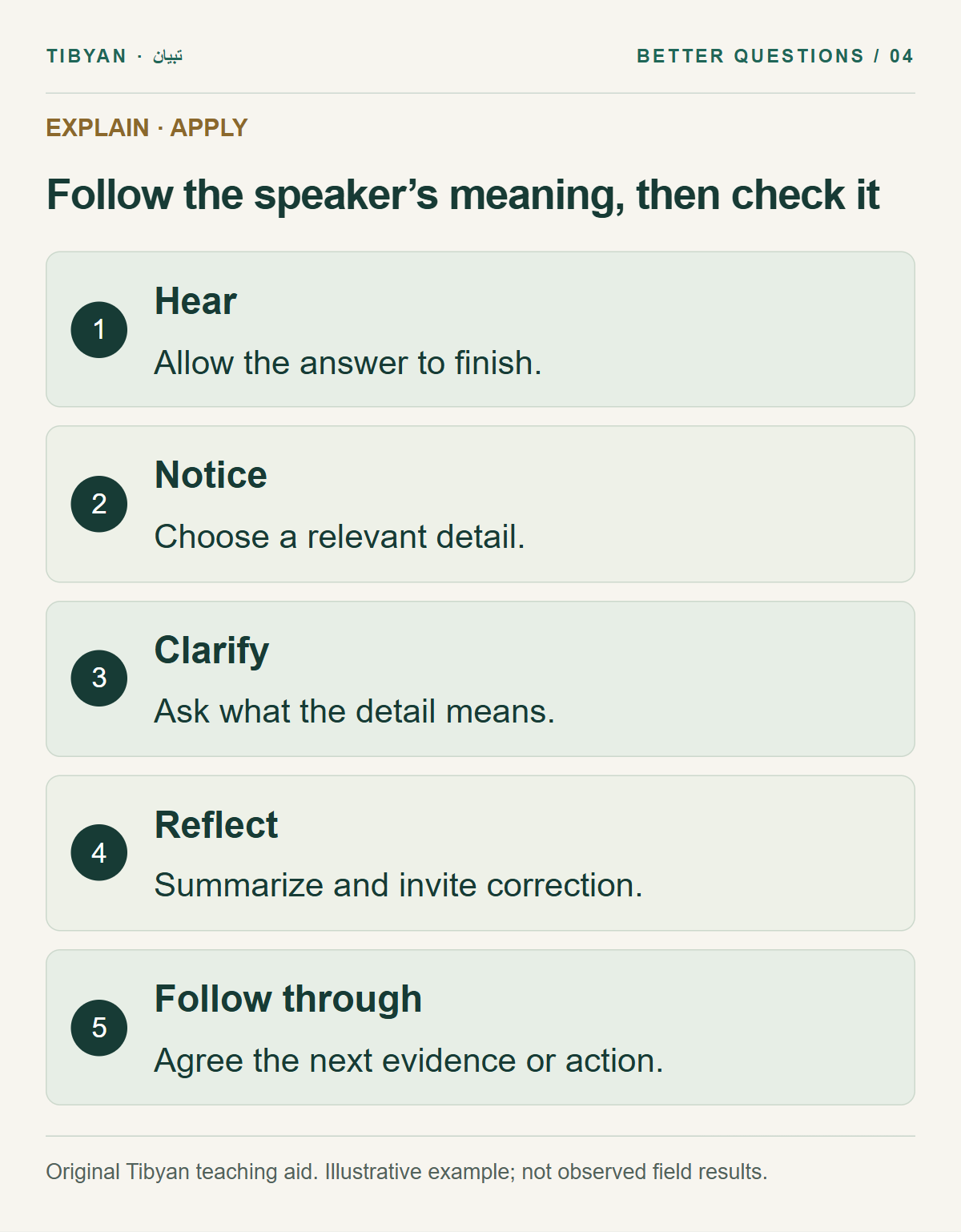
Case, demonstration and correction
Observe the follow-up at the level of a conversation turn
Fictional transcript, prepared 11 November 2026. Huda and a listener examine proposal P3. The listener may take a brief practice note; both people will use it for feedback, and it is not an employee performance rating. They agree not to record unrelated personal information.
Read Huda's first line, pause and write your own follow-up before reading the remaining turns.
| Turn | Words or action | What a reviewer can observe |
|---|---|---|
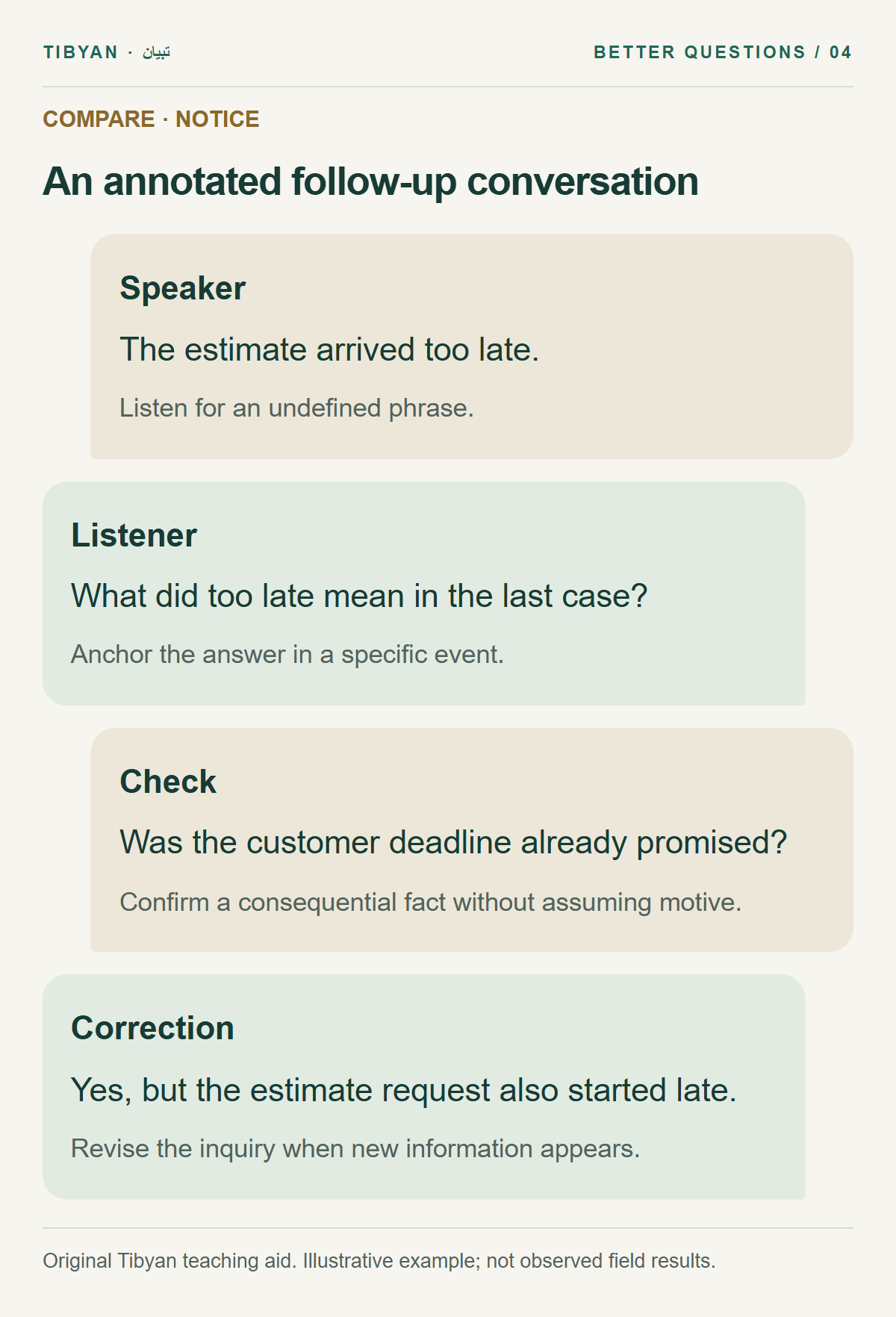
| 1 · Huda | “The estimates always arrive too late.” | “Always” and “too late” need a case and a reference point. |
| 2 · Weak listener response | “You need to plan your week better.” | Advice arrives before the timing has been established. |
| 3 · Repaired follow-up | “Which recent proposal shows the difficulty? When did the estimate arrive, and what was its deadline?” Ask the timing questions one at a time. | The listener connects the probe to Huda's actual words and checks the generalization. |
| 4 · Huda | “P3. The estimate arrived at 11:00 on 10 November; the deadline was 16:00. Internal review ended at 17:30.” | In this account, the estimate arrived before the deadline. The initial phrase did not locate the whole delay. |
| 5 · Listener and correction | Listener: “So internal review, rather than the estimate, explains the delay?” Huda: “Not all of it. The customer changed the scope at 14:30, and I sent the changed assumptions for approval at 14:45.” | The summary was too definite. Huda's correction introduces a changed condition, not merely resistance. |
| 6 · Revised follow-up | “Which assumption changed at 14:30, and what approval did that change require?” Huda: “The implementation support period changed. I needed the revised commitment confirmed.” | The next probe follows the correction. Whether that approval was necessary still requires the process rule. |
| 7 · Checked close | “Your account places the estimate at 11:00, a scope change at 14:30 and the end of internal review at 17:30. I have not checked the records, the approval requirement or when confirmation occurred. What have I missed?” They agree that Huda will bring the version history to Mariam at 16:00 on 11 November. | The close preserves reported evidence, an uncertainty and an owned next check. |
The listening improvement is visible: the listener stops defending the first explanation, uses the new detail and corrects the summary. It is not demonstrated by eye contact, warmth or the total number of questions.
Practice with explicit roles
Work in triads: speaker, listener and observer. Use three seven-minute rounds so everyone takes each role: four minutes of conversation, two minutes of evidence-based feedback and one minute to retry a missed follow-up. Allow 21 minutes for the full rotation; in a shorter lesson, complete one round and schedule the remaining rotations. The speaker uses a routine, non-sensitive difficulty. The observer records a statement, the resulting follow-up and whether the speaker corrected the summary.
Your reusable working record
Annotated completed record
Purpose and recording agreement
Huda and the listener examine P3 for practice. The observer records only task-relevant words and responses. The three participants use the notes for feedback, not a performance rating.
The record establishes purpose and the agreed use of the observation.
Observation row 1
Speaker: Estimates always arrive too late. Listener: Which recent proposal, and when did its estimate arrive? Evidence: Huda names P3 and supplies 11:00 against a 16:00 deadline.
The follow-up checks a consequential vague claim using a specific event.
Observation row 2
Listener: Internal review explains the delay? Huda: Not all of it; scope changed at 14:30. Evidence: the summary overstated the explanation and was corrected.
A correction is retained as useful information instead of being treated as a failure to agree.
Observation row 3
Listener: Which assumption changed, and what approval did it require? Huda: The support period changed and needed confirmation. Evidence: the probe follows the new scope detail.
The new question responds to the correction rather than returning to the old planning advice.
Missed opportunity and retry
I heard “always” but first offered planning advice. Retry: Which recent case should we trace, and what does too late mean in that case?
The feedback identifies an observable missed cue and an immediately usable repair.
Checked summary and disagreement
P3 estimate: 11:00; scope change: 14:30; internal review ended: 17:30, according to Huda. Records, approval requirements and confirmation time are not yet checked; the cause is not established.
Accurate representation does not require agreement with an untested diagnosis.
Owned next check
Huda brings P3’s version history to Mariam at 16:00 on 11 November; Mariam checks the approval requirement with the process owner.
The next step follows the corrected account and can be reviewed.
Next application and feedback
In the next routine handoff discussion, I will invite correction before choosing an action. My partner will identify one phrase I changed because of the answer.
The transfer plan concerns observable behavior; actual application remains to be observed.
Practice and retry
Use triads and three seven-minute rounds: four minutes of conversation, two of observer feedback and one retry. Rotate speaker → listener → observer. In each round, retain one exact speaker statement, one follow-up and one correction. For a shorter lesson, schedule the remaining rotations explicitly.
Common error and corrective feedback
“The speaker agreed with me” does not establish listening quality. Check whether the summary represented the account and allowed correction. Advice and challenge may eventually be appropriate, but they should follow an understood purpose and enough checked information.
Independent-study alternative
Cover turns 5–7. After turn 4, write a tentative summary and what could be missing. Reveal the correction, write a new follow-up, then compare it with the model. Explain which detail caused you to revise.
Check your work
- Follow-ups refer to actual answers.
- Events and interpretations are distinguished.
- A summary invites correction.
- The next step reflects the checked account.