Your reusable working recordAnnotated completed recordDownload the printable pack
Version 2 · Revised 11 November 2026 · 7/12
Diagnose the Problem Before Choosing a Solution
Build a diagnostic record that compares explanations and selects a proportionate next investigation.
Bring to the taskA defined performance gap, recent cases and people who know how the work is performed.
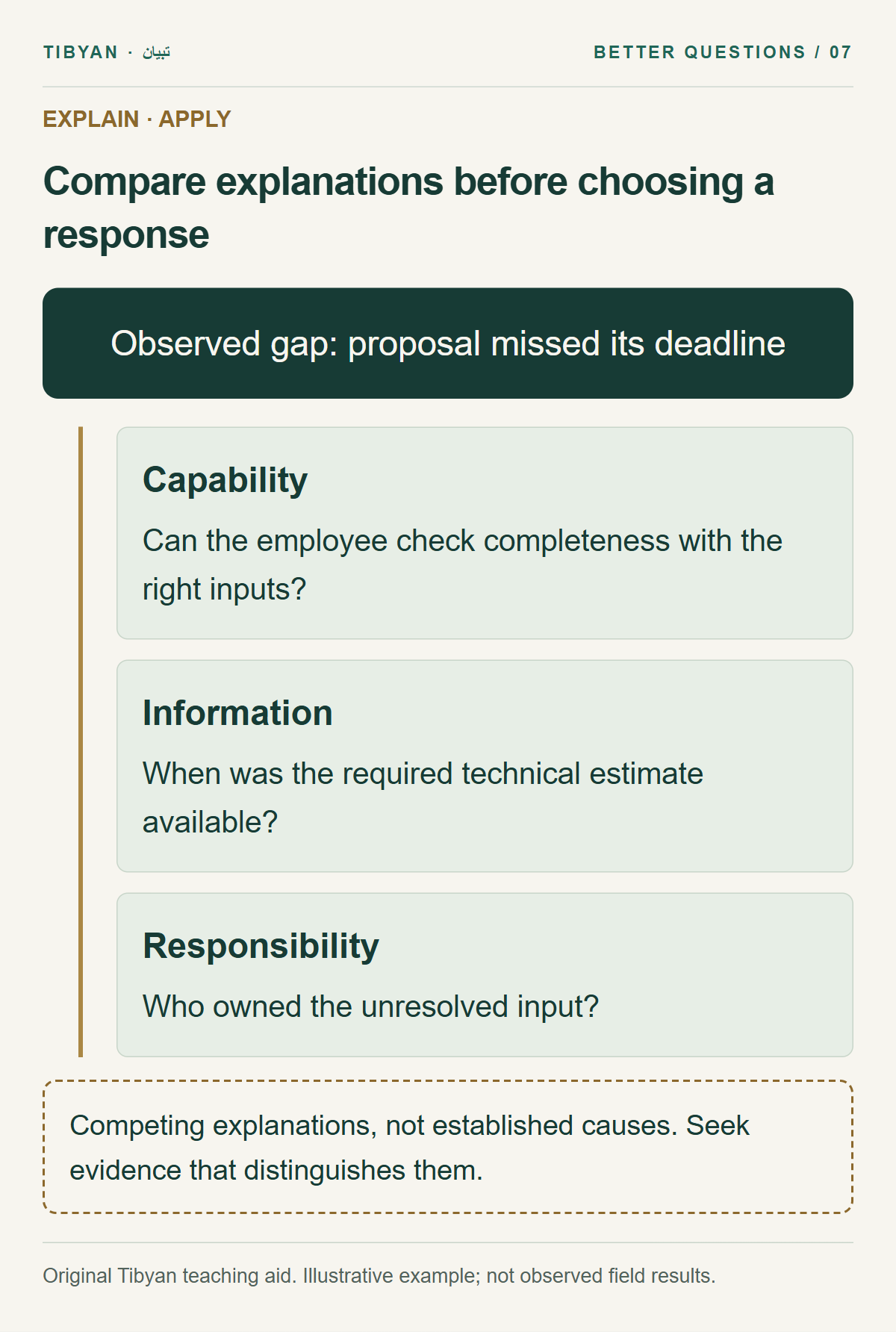
“We need another course” can be a reasonable request and an untested diagnosis. Before designing the course, ask what people need to do differently, what happens now and what prevents the desired performance. A skill gap is one possibility. Missing information, workload, incentives, access and unclear responsibility are others.
Define the gap in observable terms. “The team lacks ownership” is an interpretation. “A proposal reached its deadline without anyone confirming the technical assumptions” describes a case you can investigate. Specify the expected action and compare it with the actual sequence.
Case, demonstration and correction
Work the diagnosis with supplied records
Fictional teaching packet — all dates, records and results below are invented for practice. Namaa requires a proposal's scope and technical assumptions to be confirmed before issue. The operations manager must choose the next response by 11 November 2026. All times are on the same fictional business clock.
| Record | What the packet says |
|---|---|
| E1 · Proposal P41 | Due 4 November, 15:00. Estimate requested 3 November, 11:00; received 4 November, 17:00. Proposal issued late. |
| E2 · Proposal P42 | Due 5 November, 15:00. Estimate requested 3 November, 09:00; received at 12:00 that day. Proposal issued on time. |
| E3 · Proposal P43 | Due 6 November, 15:00. Estimate received 5 November, 11:00; proposal still late. It involved an additional service not present in P41/P42. The approval log is missing. |
| E4 · Demonstration | With complete reference information and the agreed checklist, the coordinator identified all four required assumptions omitted from a fictional practice draft. This is one supported attempt, not proof of routine proficiency. |
A completed competing-explanations matrix
| Explanation and prediction | Support | Challenge or uncertainty | Discriminating check |
|---|---|---|---|
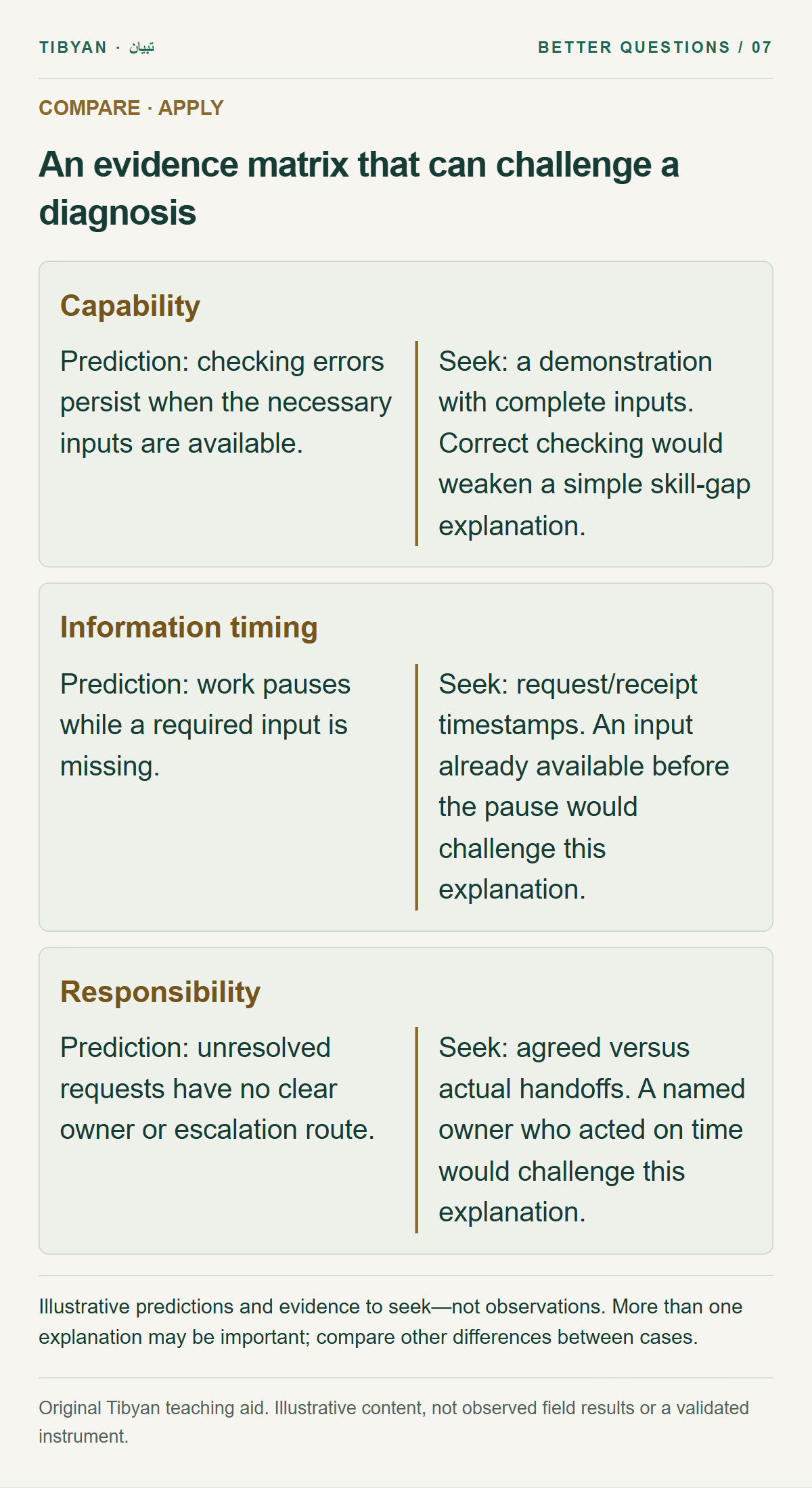
| Missing capability: checks fail even with clear inputs and time. | No direct skill-failure evidence is supplied; P43’s lateness makes the specific task worth examining. | E4 weakens a general inability claim; P43 may involve extra complexity. | Observe the additional-service check with current instructions; inspect the reasoning, not just completion. |
| Information timing: a required input arrives after the commitment. | E1's estimate arrived two hours after the deadline. | E3 had an earlier estimate, so timing alone does not explain every case. | Trace request, receipt and change timestamps; check whether the received estimate was complete. |
| Unclear responsibility: unresolved items wait because no role owns escalation. | The P43 approval log cannot identify an owner. | A missing log is not proof that no one acted. | Ask the coordinator and approver separately, then inspect the message assigning the unresolved item. |
Reasoned next decision: operations manager Salma will retrieve the P43 messages and observe one additional-service completeness check before commissioning training. If the coordinator can perform the check but the item had no acknowledged owner, Salma will test an explicit escalation handoff on the next three suitable proposals. If the check fails despite adequate inputs and instructions, she will add targeted practice with feedback. She will review at the third eligible proposal, or earlier if an unconfirmed commitment is about to be issued. Information and capability problems may coexist.
Weak response: “Two late proposals prove poor time management.” It converts a small, selected packet into a causal conclusion. Improved response: “This packet makes information timing plausible for P41 and leaves P43 unresolved; obtain the missing approval trail before choosing the intervention.”
Your reusable working record
Annotated completed record
Expected and observed performance
Scope and assumptions must be confirmed before issue. P41 and P43 missed their stated deadlines; P42 did not. Packet: 3–6 November 2026, fictional.
The gap uses named cases and an explicit standard; it does not estimate the company-wide delay rate.
Explanation 1: prediction, support and challenge
Capability: predict a failed completeness check with adequate inputs. Support: no direct evidence of a failed check; lateness alone is nondiagnostic. Challenge: E4 succeeded; P43 is more complex. Next: observe the extra-service check.
The late outcome is not treated as direct evidence of a skill deficit.
Explanation 2: prediction, support and challenge
Information timing: predict the estimate arrives after commitment. E1 supports this; E3 challenges timing as the sole explanation. Check completeness and change timestamps.
A supported explanation for one case need not explain every case.
Explanation 3: prediction, support and challenge
Ownership: predict unresolved items lack acknowledged escalation. P43 owner unknown because log missing. Obtain messages and compare two accounts.
The entry keeps the absence of a log distinct from the absence of responsibility.
Source/date and confounding conditions
E1–E4, fictional packet checked 11 November 2026. P43 includes an additional service; workload and approval messages remain unknown.
Named exhibits make the inference auditable; the extra service is an alternative explanation.
Next evidence check and owner
Salma retrieves P43 messages and observes the additional-service completeness check before choosing training or a process repair.
The check distinguishes support conditions from task capability.
Conditional response and review trigger
Successful check + no acknowledged escalation: test explicit ownership on three eligible proposals. Failed supported check: add targeted practice. Review at proposal 3, or before an unconfirmed issue.
Both findings lead to different, bounded actions; neither establishes a revenue effect.
Practice and retry
Complete the matrix from E1–E4 before reading the worked decision. Then add this new fictional fact: P43’s message assigned escalation to sales, but the coordinator did not receive it. Revise one explanation and the next check; do not merely add the fact to your original conclusion.
Common error and corrective feedback
Watch for diagnosing a trait from an outcome, treating missing documentation as proof of inaction, and assuming contrasting cases differ in only one condition. A defensible alternative may retain several interacting explanations.
Independent-study alternative
Cover the worked matrix, complete your own, then compare the predictions and uncertainties rather than matching its wording. Write one reason your first diagnosis might fail.
Check your work
- The gap concerns observable work.
- Competing explanations have different predictions.
- Contradictory evidence is considered.
- The next check could change the response.