Your reusable working recordAnnotated completed recordDownload the printable pack
Version 2 · Revised 11 November 2026 · 10/12
Use AI to Develop a Better Inquiry
Use an AI dialogue to improve an inquiry plan, while recording what you accepted, rejected and still need to verify.
Bring to the taskA defined task, permitted non-sensitive context, your initial view and access to reliable sources.
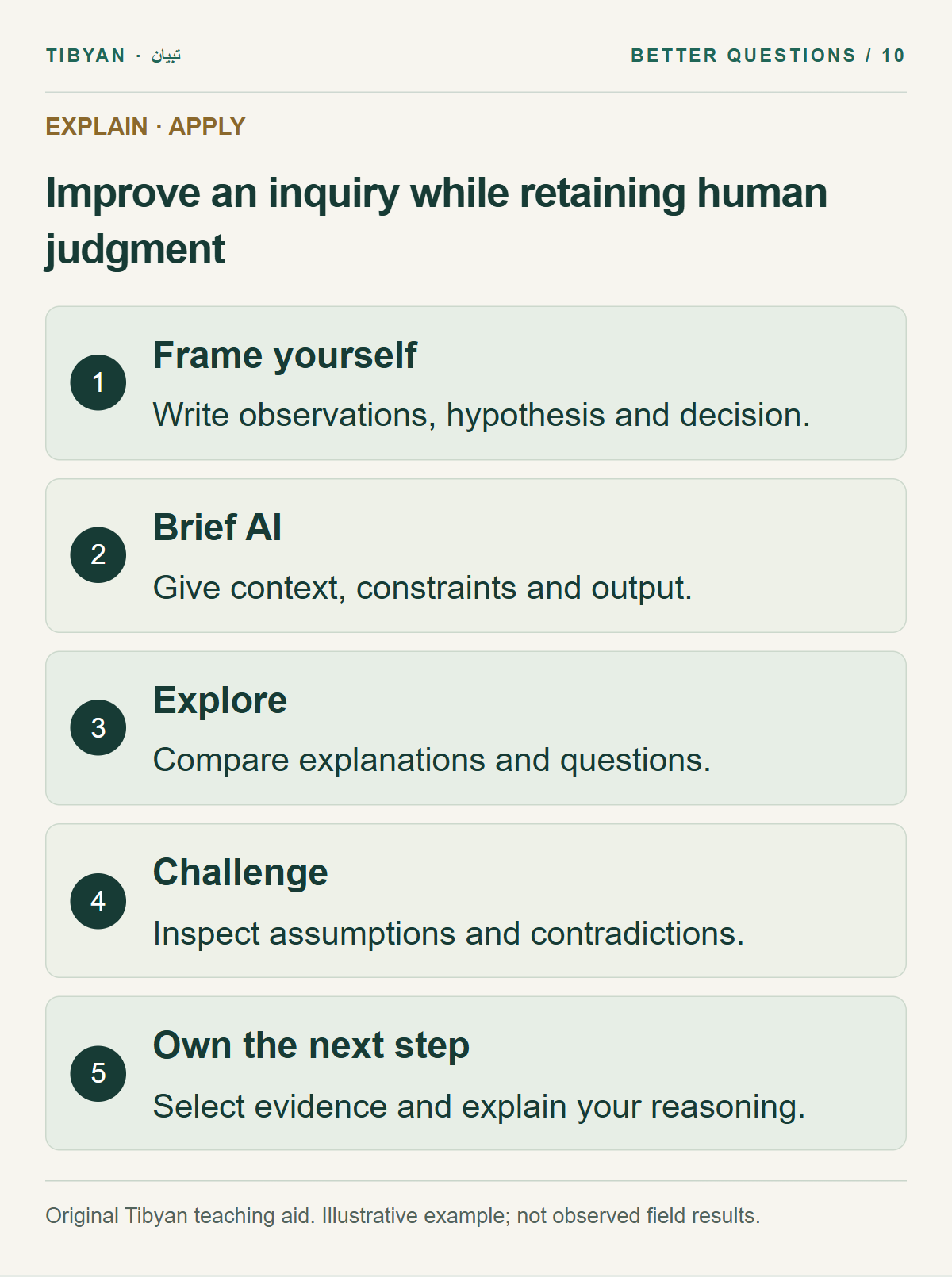
“Give me the best solution” encourages a finished recommendation before the problem is understood. A more useful starting request asks the system to examine the decision, assumptions and missing evidence. The goal is an improved investigation, not a more persuasive answer to an untested premise.
Write your own initial account before opening the AI tool. What do you observe, what do you currently think and which choice matters? Keep it available so you can see whether the dialogue changed your reasoning or merely supplied more fluent language. Use fictional or appropriately anonymized examples and follow your organization’s information rules.
Case, demonstration and correction
An annotated dialogue that changes the inquiry
Illustrative dialogue authored for this lesson, revised 11 November 2026. It is not a transcript or a benchmark of any AI product. The supplied facts are that fictional proposals P41 and P43 were late, P41’s estimate arrived after its deadline, and the P43 approval log is missing. No information about employee motivation is supplied.
Before using AI — the manager's draft: “We should improve planning. Why does the coordinator leave work late? Which time-management course should we buy?” The draft treats a suspected cause as the starting explanation and selects a remedy too early.
Human: I must choose our next investigation. P41's technical estimate arrived after its deadline; P43 was late but its approval trail is missing. Separate facts from hypotheses. Offer questions and the evidence that could change our response.
AI, intentionally flawed response: Lateness shows low motivation. Start with a planning course and ask why the coordinator does not prioritize proposals. The missing P43 approval log also proves that no one owned the unresolved item.
Human: Which supplied fact supports low motivation? Treat it as untested, not diagnosed. Compare information timing, capability and ownership, and state what each explanation would predict.
AI, revised draft: The packet does not establish motivation. Timing predicts a late or incomplete estimate; capability predicts errors even with clear, complete inputs; ownership predicts unresolved items without acknowledged escalation. Check timestamps, observe a completeness check and inspect assignment messages.
Human: A missing approval log does not prove absent ownership. Rewrite the ownership question without that assumption and identify a feasible first check.
AI, revised draft: Ask: “Who was responsible for the unresolved item, and how was that responsibility communicated?” First retrieve the P43 assignment messages and ask the coordinator and approver to correct the sequence.
The human judgment log
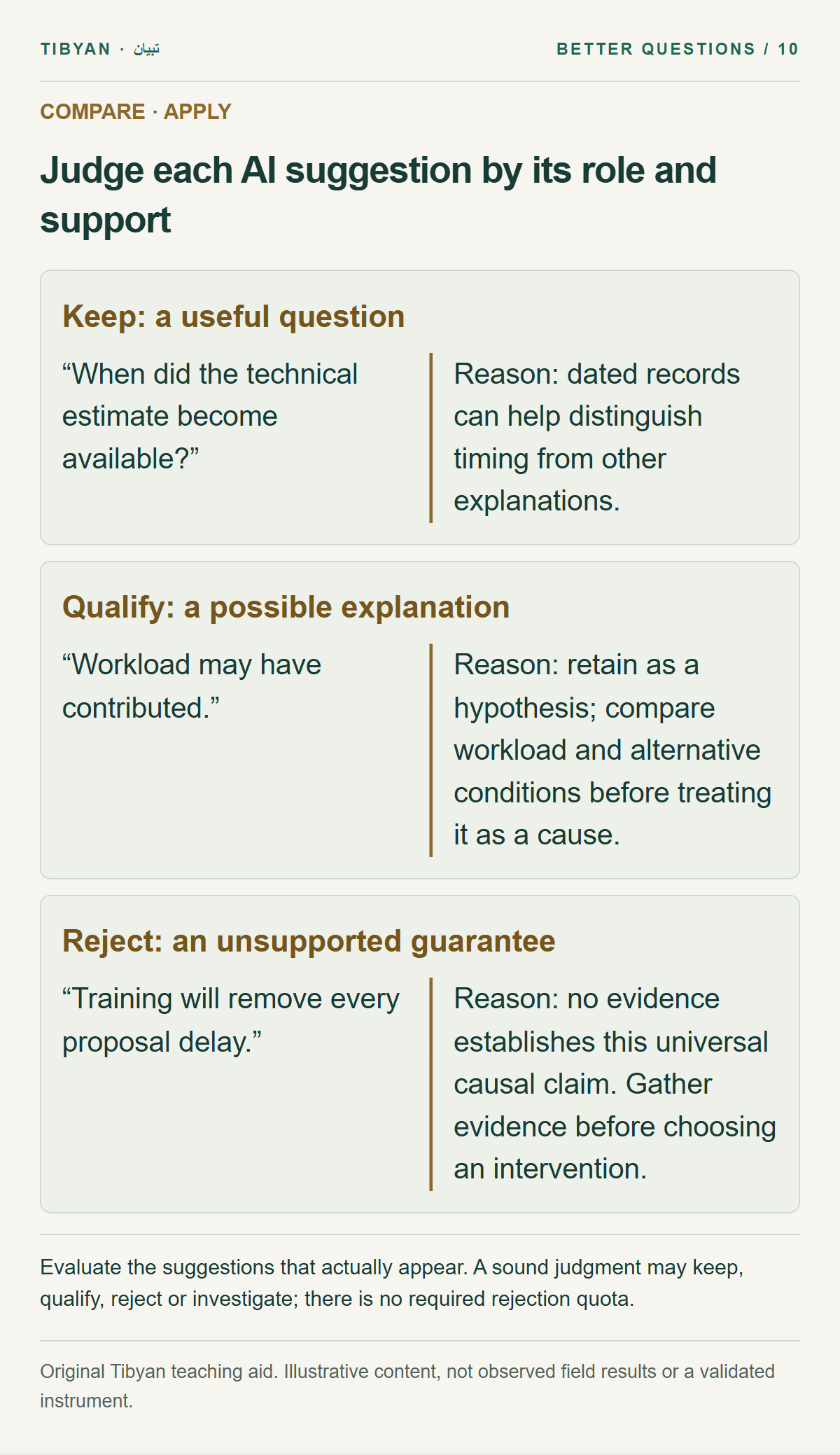
| Suggestion | Judgment and reason | Next use |
|---|---|---|
| “Lateness shows low motivation.” | Reject the diagnosis: the supplied observations do not support it. Motivation may be a hypothesis only if relevant evidence later warrants examining it. | Do not use it to choose training or label the employee. |
| Compare request/receipt timestamps. | Retain: records could distinguish late information from another explanation. Their completeness must be checked. | Request the dated handoff trail. |
| No log means no owner. | Qualify: missing documentation leaves ownership unknown. | Ask about responsibility and communication, then inspect messages. |
After dialogue — the manager's inquiry plan: “First retrieve the P43 trail. Ask who owned the unresolved item and how the request reached them. Observe a supported completeness check if the trail does not explain the gap.” Salma owns the evidence request and reviews it before choosing an intervention.
Independent explanation with the dialogue closed: “I am investigating the handoff before buying training because information timing and responsibility could change the response. I have not diagnosed motivation or ruled out a skill gap.”
This exercise contains an intentional error so a justified rejection can be practiced. In real work, there is no requirement to reject a fixed number of suggestions. Retain, qualify or reject each on its merits; record why, including when every suggestion is inadequate or none needs rejection.
Your reusable working record
Annotated completed record
My plan before AI
I initially suspect poor planning and ask which course to buy. The cause is not established.
The original assumption is preserved so change can be inspected.
Permitted facts, hypotheses and unknowns
Fictional facts: P41 and P43 were late; P41’s estimate arrived after its deadline; P43’s approval log is missing. Hypothesis: planning. Unknowns: completeness, ownership, capability and motivation. No confidential client data supplied.
The brief does not quietly promote a hypothesis to fact.
Useful turns and human challenges
I asked the AI for the evidence behind motivation, required competing predictions and challenged the equation of a missing log with absent ownership.
Human challenges target specific unsupported inferences.
Suggestion → judgment → reason → next check
“Lateness shows low motivation” → reject as diagnosis → no supporting fact → avoid employee label; examine only if later evidence warrants it.
Rejection concerns the inference; it does not prove motivation irrelevant in every case.
Suggestion 2 and judgment
Request/receipt timing → retain → a dated trail could alter the intervention → obtain the relevant messages and check whether inputs were complete.
A useful question is retained as a question, not accepted as a causal answer.
Suggestion 3 and qualification
No log means no owner → qualify → log missing, ownership unknown → ask who held responsibility and how the request was communicated.
Qualification keeps a testable uncertainty without repeating the AI assumption.
Revised inquiry and owner
Salma retrieves P43 messages, checks responsibility/communication with both roles, then observes a supported completeness check if the gap remains unexplained.
The plan sequences checks rather than repeating a list of topics.
Independent explanation and remaining uncertainty
The handoff trail could change whether we repair communication or provide practice. Neither motivation nor a skill deficit is established.
The learner must justify the next step, not reproduce fluent AI language.
Assistance record and review point
Teaching dialogue authored by Tibyan, revised 11 November 2026; no model benchmark claimed. Salma reviews the retrieved trail before an intervention is approved.
The provenance distinguishes an illustration from an observed model interaction.
Practice and retry
Write your own three-question plan from the fictional brief, then evaluate every consequential AI suggestion using retain/qualify/reject and a reason. Use the seeded dialogue if no AI is available. Finish with a new explanation without the transcript, and say what actual evidence is still required.
Common error and corrective feedback
Common errors: accepting a plausible explanation as a fact; rejecting a suggestion merely to meet a quota; claiming that a better-written prompt guarantees reliable reasoning; judging learning only by the polished assisted plan.
Independent-study alternative
Use the authored AI response as a critique exercise. Annotate facts, hypotheses and unjustified conclusions, then write a revised brief and a next evidence step. This does not require access to a model.
Check your work
- The human starting view is recorded.
- Facts and hypotheses remain distinct.
- AI suggestions receive explicit judgment.
- The next step can be explained independently.