The Power of Better Questions
Facilitator guide
Version 2 · Revised 11 November 2026
Use the learner workbook as the exact case and visual packet. Each lesson below identifies the demonstration, practice, feedback, retry and follow-up. A 45–60-minute lesson is a planning estimate to pilot: 5 opening, 10 demonstration, 15 practice, 10 feedback/retry, 5 transfer planning, plus up to 15 for another attempt.
Paired session 1: Why Better Questions Matter + How to Ask Clear, Useful Questions
90–120 minutes for the two lessons: 10 minutes recall and task framing; 20 study and demonstration; 25 first task; 25 second task with feedback; 10 revision and next application. Optional 30 minutes for a fresh attempt. Schedule the 20-minute baseline and final assessments separately. Fieldwork occurs between sessions, not inside this timetable.
Paired session 2: Questions That Improve Learning and Critical Thinking + Listen Carefully and Ask Better Follow-Up Questions
90–120 minutes for the two lessons: 10 minutes recall and task framing; 20 study and demonstration; 25 first task; 25 second task with feedback; 10 revision and next application. Optional 30 minutes for a fresh attempt. Schedule the 20-minute baseline and final assessments separately. Fieldwork occurs between sessions, not inside this timetable.
Paired session 3: Questions for Leadership, Coaching, and Team Learning + Customer Discovery: Ask Questions That Reveal Real Needs
90–120 minutes for the two lessons: 10 minutes recall and task framing; 20 study and demonstration; 25 first task; 25 second task with feedback; 10 revision and next application. Optional 30 minutes for a fresh attempt. Schedule the 20-minute baseline and final assessments separately. Fieldwork occurs between sessions, not inside this timetable.
Paired session 4: Diagnose the Problem Before Choosing a Solution + Use Questions to Generate Ideas and Explore Opportunities
90–120 minutes for the two lessons: 10 minutes recall and task framing; 20 study and demonstration; 25 first task; 25 second task with feedback; 10 revision and next application. Optional 30 minutes for a fresh attempt. Schedule the 20-minute baseline and final assessments separately. Fieldwork occurs between sessions, not inside this timetable.
Paired session 5: Ask Better Questions Before Making Business Decisions + Use AI to Develop a Better Inquiry
90–120 minutes for the two lessons: 10 minutes recall and task framing; 20 study and demonstration; 25 first task; 25 second task with feedback; 10 revision and next application. Optional 30 minutes for a fresh attempt. Schedule the 20-minute baseline and final assessments separately. Fieldwork occurs between sessions, not inside this timetable.
Paired session 6: Question AI’s Answers and Verify the Evidence + Build a Lasting Questioning Practice
90–120 minutes for the two lessons: 10 minutes recall and task framing; 20 study and demonstration; 25 first task; 25 second task with feedback; 10 revision and next application. Optional 30 minutes for a fresh attempt. Schedule the 20-minute baseline and final assessments separately. Fieldwork occurs between sessions, not inside this timetable.
Why Better Questions Matter
Open the editable working tool · Explanatory figure · Comparison/example figure
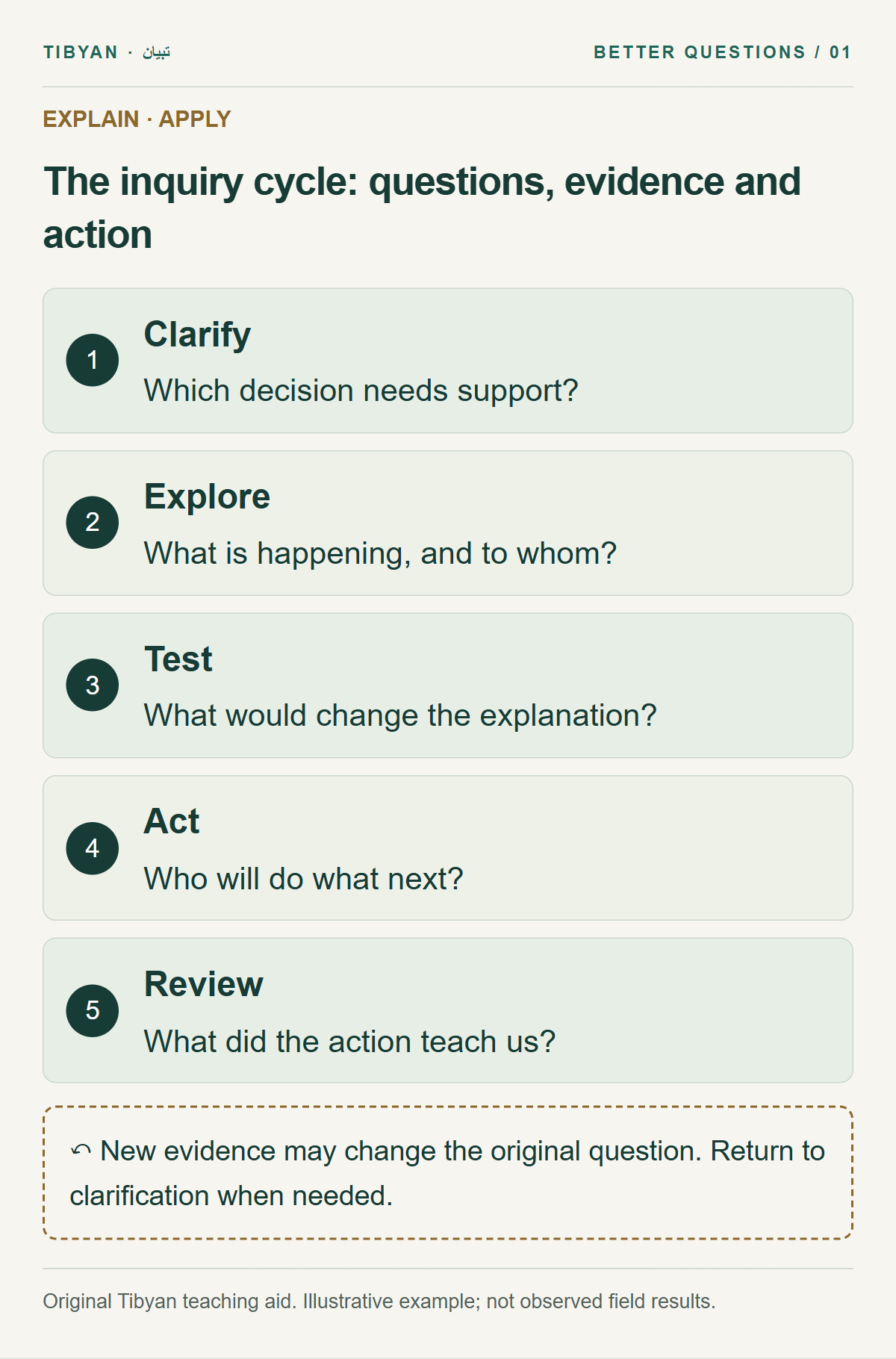
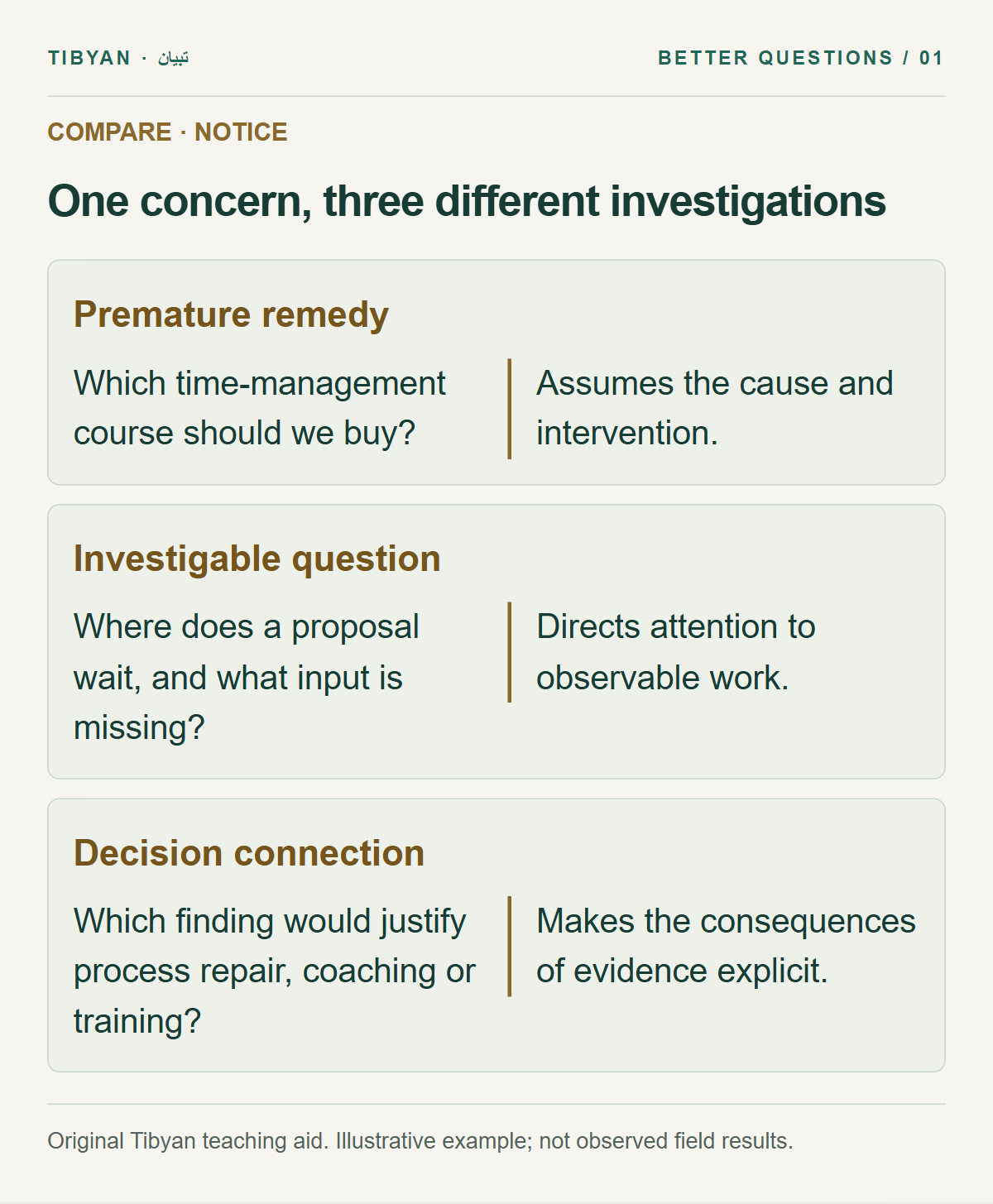
Preparation: give learners the three records and keep the model hidden. Demonstrate the distinction between the P1 timestamp and an explanation for it. Practice: individuals draft a question, then pairs exchange conditional actions. Feedback: ask “Which case weakens your preferred explanation?” and “What would you do if the demonstration is accurate?” Retry after supplying the missing condition that Huda had another urgent assignment; accept a revised question about workload rather than a required diagnosis.
Practice and retry
Use the supplied packet to complete the record before viewing the model. Write two findings that would lead to different actions. Then ask a partner to introduce one missing condition and revise the question or next check.
Common error and corrective feedback
Weak: “All delays are caused by poor planning.” Correction: the records show different sequences and leave complexity/workload unknown. A supported next step investigates P1 and P3; it does not announce a cause.
Model feedback anchors
Decision and deadline
Mariam chooses a bounded response to proposal delay by 12 November 2026. Customer deadlines stay fixed.
The choice, authority and deadline are visible; the record does not start by buying a course.
Observed records
P1 received its confirmed estimate after the deadline. P3 received its estimate at 11:00 but the draft was submitted at 18:00 against a 16:00 deadline.
P3 prevents the record from quietly treating every late draft as a late-estimate case.
Investigation question
Where did time accumulate from estimate request to draft submission in P1 and P3?
It selects an observable sequence and leaves several explanations possible.
Explanations and missing information
Possible explanations: request ownership, input timing, checking skill or competing workload. Case complexity and workload are not supplied.
Missing context is retained rather than invented.
Next check and people
At 15:00 on 11 November, Huda and Omar reconstruct P1/P3 and demonstrate the completeness check using the draft histories and timestamps.
The check can reveal both a process condition and a skill need.
How findings change the action
If timely inputs permit correct checking but requests lack ownership, test an owned request/escalation step. If checking errors remain with adequate inputs and time, rehearse the specific checking step.
The responses follow different findings; neither is already declared effective.
Responsibilities
Mariam authorizes and reviews the response; Huda brings draft histories; Omar verifies estimate timestamps.
Roles are assigned in the completed example rather than left as an instruction.
Review point and limit
Review the next three eligible proposals for use of the agreed step and remaining obstacles. Do not infer revenue impact from this small review.
The review examines implementation and learning, with a stated limit.
Independent-study alternative
Write your record first. Then read the model and mark one place where it preserves an unknown you had treated as a fact. Revise that part and explain the changed action.
How to Ask Clear, Useful Questions
Open the editable working tool · Explanatory figure · Comparison/example figure
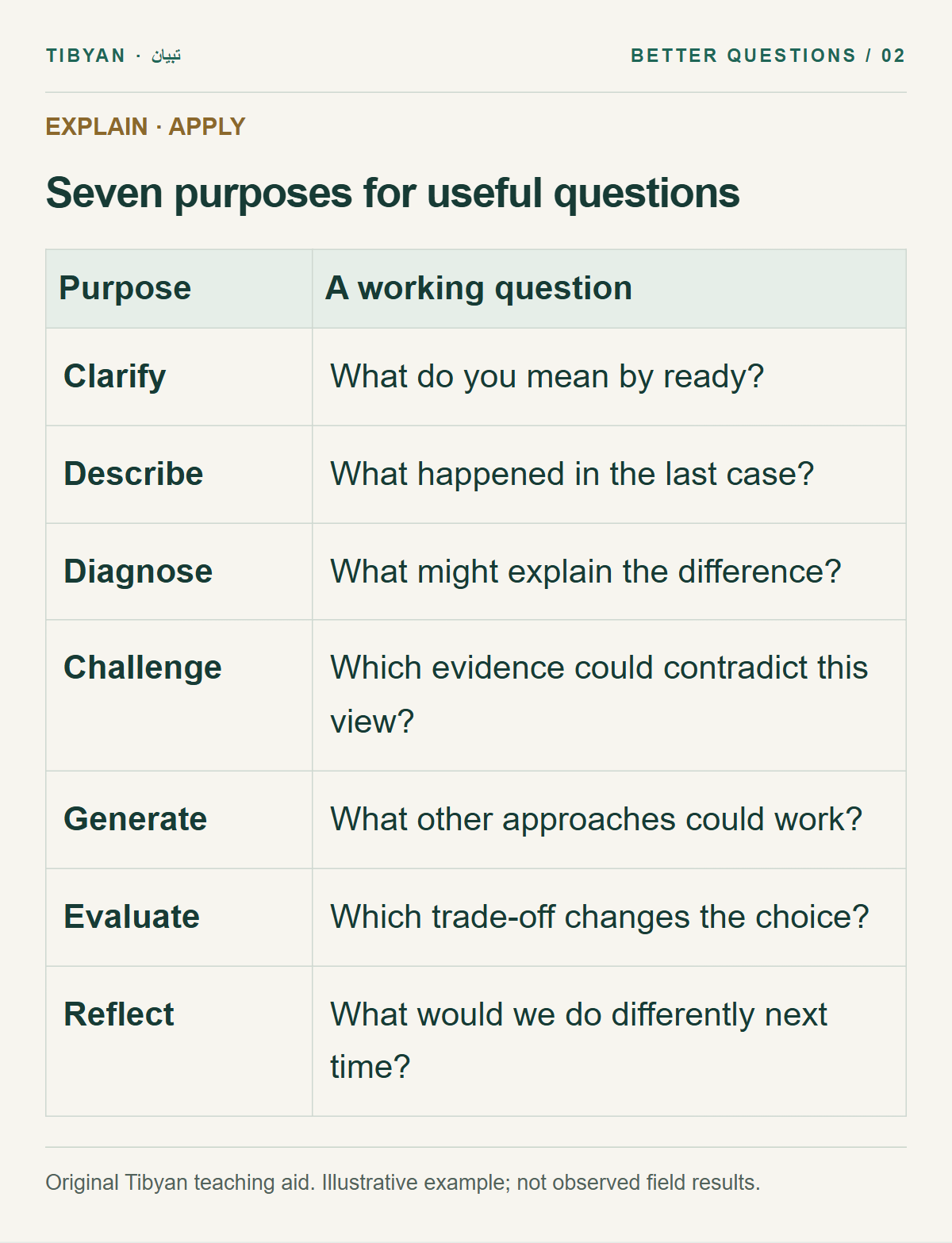
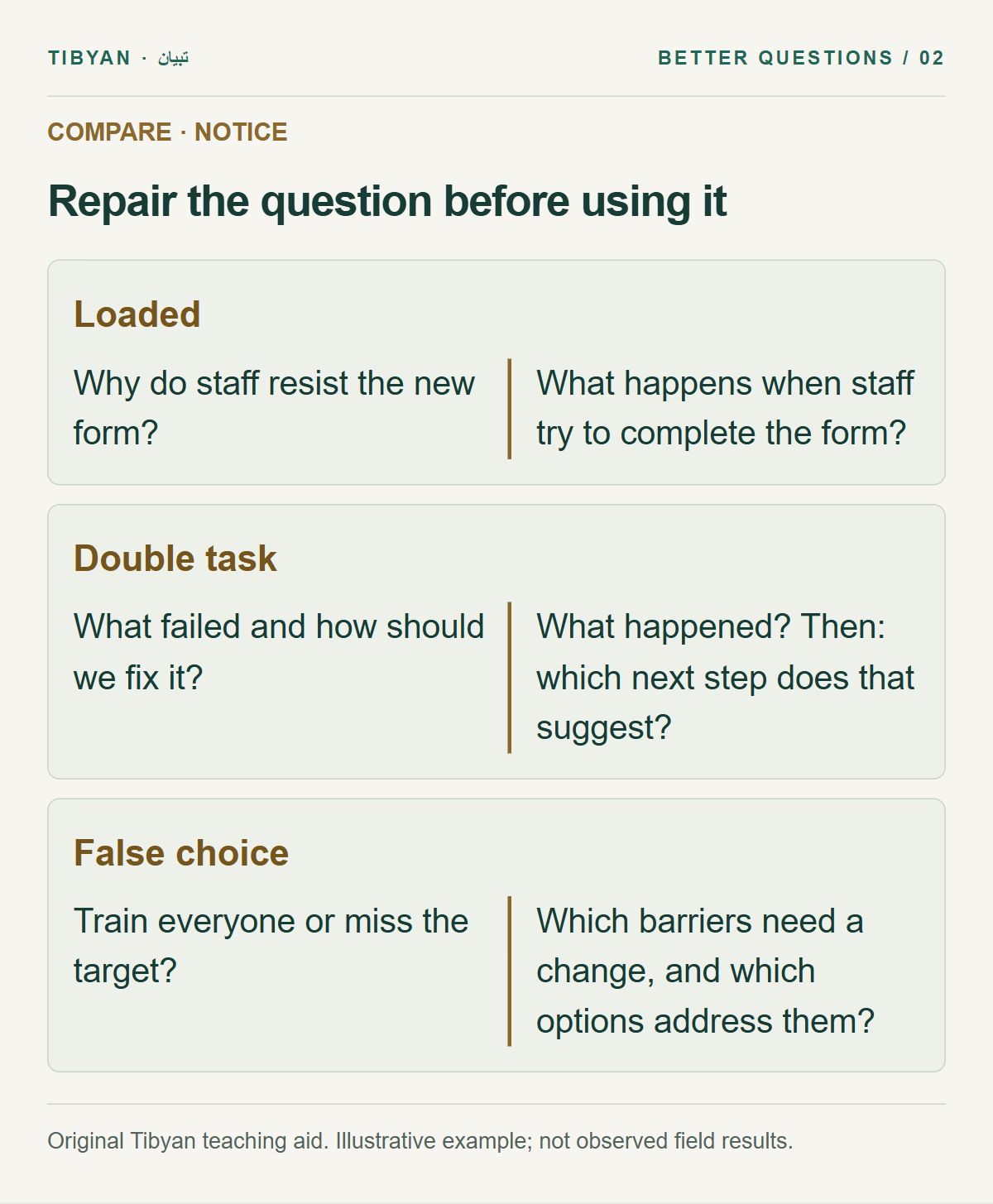
Give the five originals without the key. Have a partner answer each literally, including “there was no saving” or “nothing was missing.” Ask the questioner to revise rather than defend the premise. Compare alternatives by what answers they permit. Demonstrate one conditional follow-up. Retry with the questioner learning that the request went to a shared inbox, not a named person. Feedback should identify a premise, an extra task or a missing term; do not require the exact model wording.
Practice and retry
Repair the five original questions before reading the table. For each, justify the change and provide a different acceptable wording. In a five-minute conversation, use three questions and document one answer-dependent follow-up.
Common error and corrective feedback
A question is not neutral merely because it begins with “what.” “What made you ignore the request?” still assumes ignoring. Investigate receipt and action first. Closed questions are acceptable when the missing fact is bounded; an unverified answer is not automatically established evidence.
Model feedback anchors
Repair row 1
Original: How much time did the form save? Purpose: compare preparation effort. Problem: assumes a saving. Repair: What changed in preparation and checking time? Alternative: What took more or less time in the latest case? If no change: Which step stayed the same?
The repair admits an unfavorable answer; it does not replace one preferred answer with another.
Repair row 2
Original: Why is quality bad? Purpose: understand the approval sequence. Problem: quality is undefined. Repair: What happened during P3’s approval review? Alternative: Which requirement, if any, was unmet? If information was complete: What step followed the review?
The alternative does not assume missing information when the event may have another explanation.
Repair row 3
Original: Why was P3 late, who failed, and how will you fix it? Purpose: reconstruct the sequence. Problem: multiple tasks and assumed blame. Repair: What happened after the estimate arrived? Alternative: Talk me through those steps. If review paused work: What did the review require?
Only the first needed task is asked; responsibility and remedies can follow checked information.
Repair row 4
Original: Why do you keep ignoring requests? Purpose: trace one request. Problem: assumes intention and repeated neglect. Repair: When did you first see the 10 November request? Alternative: What happened to that request? If it arrived late: How was it routed?
The record investigates delivery and responsibility without asserting motive.
Repair row 5
Original: Train everyone or accept missed deadlines? Purpose: choose a response. Problem: excludes other feasible responses. Repair: Which responses could address the observed gap? Alternative: What could change besides training? If an ownership repair is proposed: Which case would let us examine it?
A process repair remains an option to investigate, not a proven solution.
Selected conversation sequence
Which case are we discussing? → What happened after the estimate arrived? Speaker: internal review paused it. → What did that review require?
The third question follows the actual answer rather than the next item on a fixed list.
Partner correction and revision
My partner noted that “Which information was missing?” assumed a deficit. I changed it to “What happened during the approval review?” and kept the information question only if the answer supports it.
The revision explains why a more neutral opening was needed.
Independent-study alternative
Write a repair for every original, then compare with the key. Imagine an answer that contradicts your premise and write the next question you would actually ask. Explain one difference between your wording and the model.
Questions That Improve Learning and Critical Thinking
Open the editable working tool · Explanatory figure · Comparison/example figure
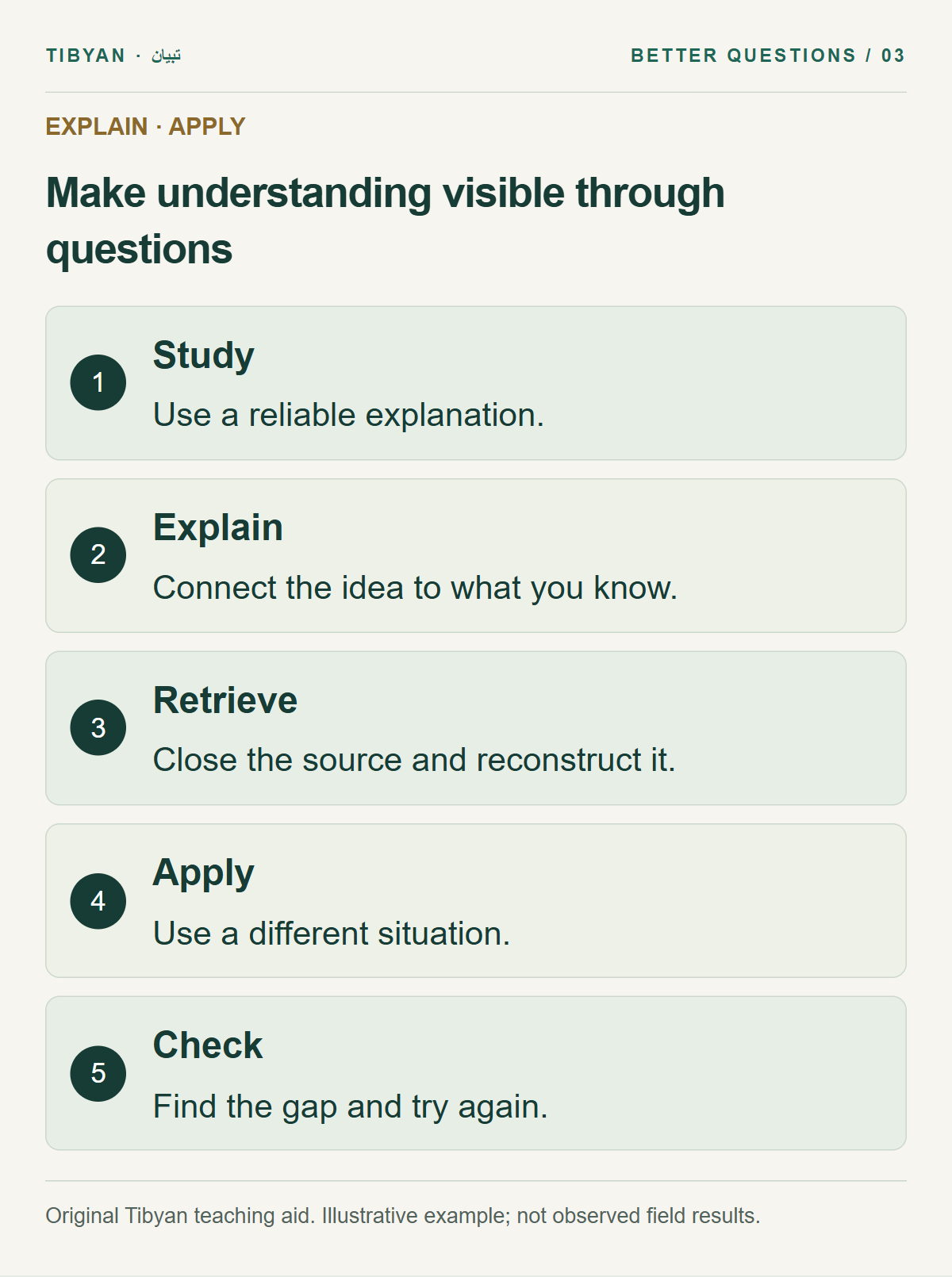
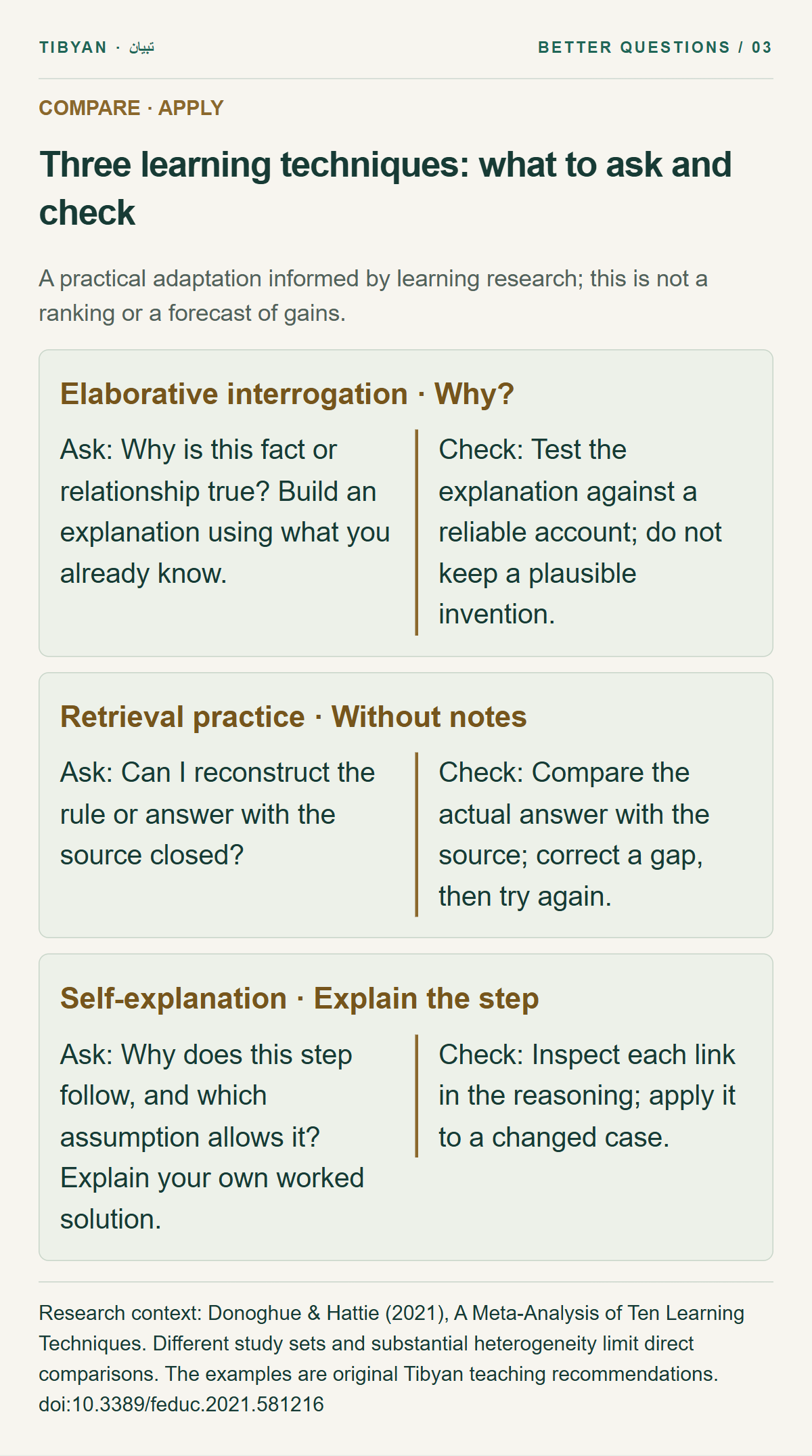
Preparation: separate the explanation, Case A model and Case B key so learners do not see the answer during an independent attempt. Model one error diagnosis on Case A. For Case B, require an answer and reason before revealing the security condition. Feedback: “Which requirement sets the latest input time?” and “Which premise changed?” Offer another attempt with a different optional item. Judge use of the rule and conditions separately from arithmetic. The supplied exercise is an original teaching aid; it does not validate the whole learning sequence.
Practice and retry
Study the supplied explanation and work Case A. Close it and explain the dependency rule in your own words. Answer Case B unaided, then respond to the security-approval change. Compare with the key, identify the reasoning gap and complete one fresh case later without the old response.
Common error and corrective feedback
Do not score a correct time as full understanding if the reason is wrong or missing. “All tasks must finish” and “the optional task never matters” both overgeneralize: an explicit rule change can make that task mandatory. Ask the learner to identify what the current rule requires and what remains unknown.
Model feedback anchors
Concept and supplied rule
A required dependency is an input or action the process requires before proceeding. In Case A, confirmed estimate and verified scope are required; the cover is optional.
The concept is tied to a supplied rule rather than assumed business knowledge.
First answer before feedback
I first chose 16:20 because I treated every listed item as required.
The record preserves the error so that the correction can be examined.
Feedback and error diagnosis
The rule does not require the cover. I confused a listed item with a mandatory dependency.
The feedback targets classification of requirements, not the learner’s personality.
Corrected Case A response
13:20: scope is the last required input at 13:00; the check takes 20 minutes. This assumes the checker is available and records are complete.
Both the timing calculation and conditions are explicit.
Explanation produced with the source closed
An earlier item may be independent or optional. A later task waits only if the rule or task requires that output.
This is actual retrieved reasoning, not “Can I explain it?”
Unaided Case B answer
10:45: the checklist and test report are ready at 10:30; add the 15-minute handoff check. The optional video does not delay handoff.
The answer transfers the distinction to a different process.
Response to the new mandatory condition
With security approval required at 11:00, the earliest handoff becomes 11:15. Keeping 10:45 would ignore a mandatory input.
The new conclusion depends on the new rule, not on copying the first answer.
Next independent attempt and criterion
In a new project task, I will mark each listed item required, optional or unknown, give the earliest permitted next step, and explain one condition that would change it. A partner will check my labels against the supplied rule.
The next attempt targets the identified classification error; no improvement is claimed before it is observed.
Independent-study alternative
Cover the model answers while attempting each case. Write your reason before uncovering the key. If the time is correct but the reason is not, mark the explanation as needing revision and retry with the changed condition.
Listen Carefully and Ask Better Follow-Up Questions
Open the editable working tool · Explanatory figure · Comparison/example figure
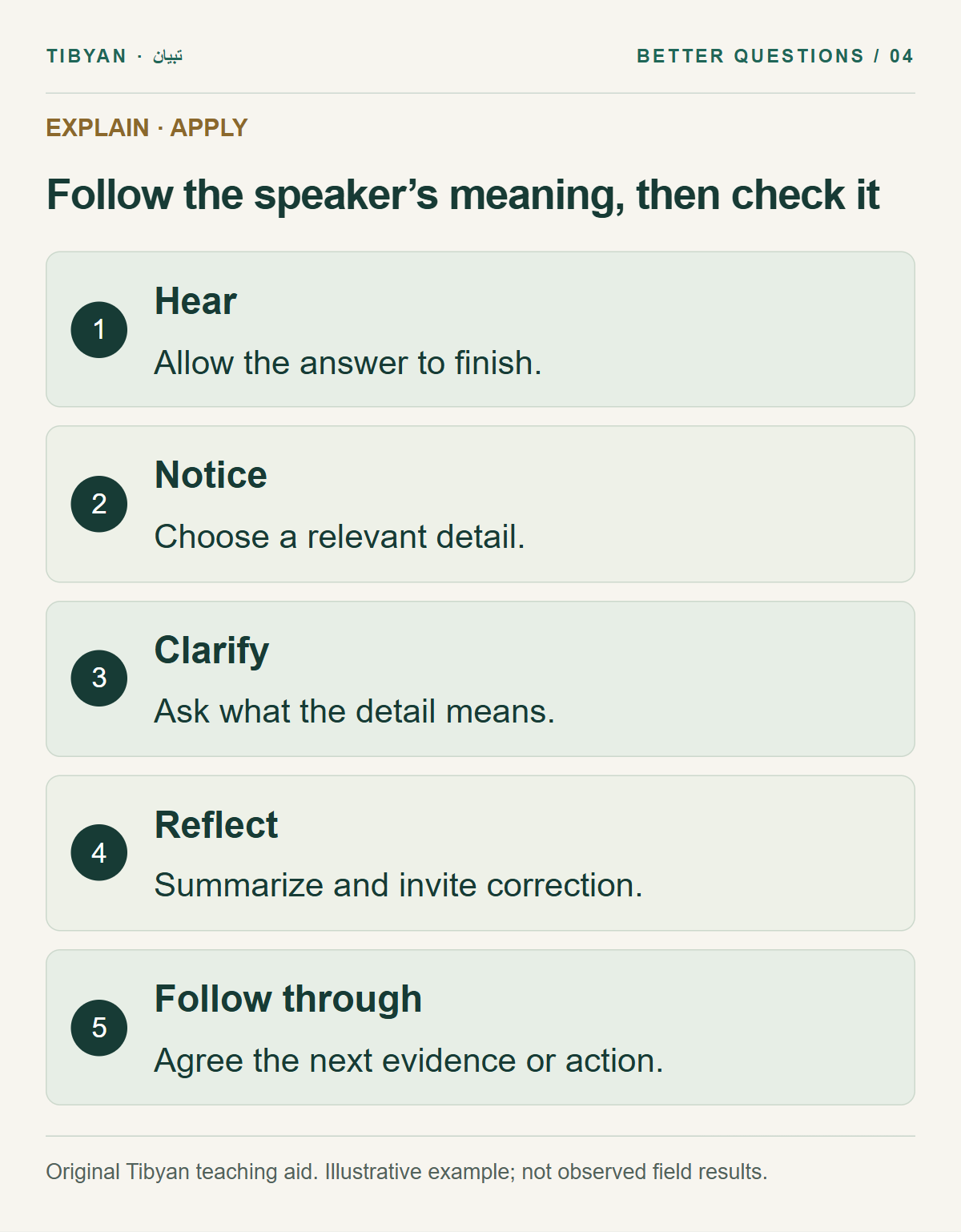
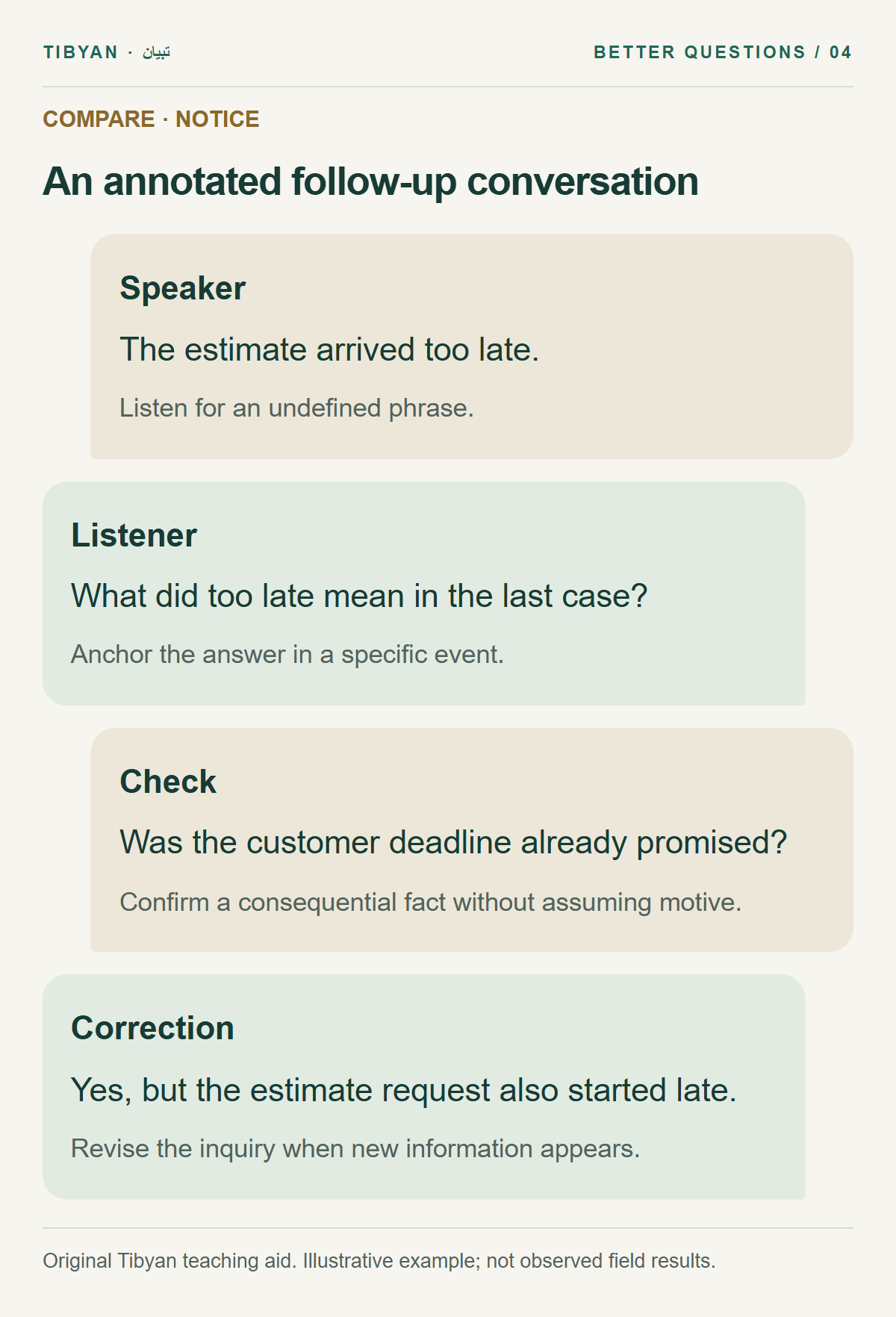
Prepare transcript turns 1–4 separately from the correction in turn 5. Pause after the listener’s overconfident summary; ask learners to predict what might be missing. Reveal the scope change and require a new follow-up before showing turn 6. During triads, interrupt only to identify a concrete advice-before-inquiry turn, then let the listener retry. Feedback prompts: “Which exact words shaped your follow-up?” and “What did you change after the correction?” Do not score personality, eye contact or number of questions.
Practice and retry
Use triads and three seven-minute rounds: four minutes of conversation, two of observer feedback and one retry. Rotate speaker → listener → observer. In each round, retain one exact speaker statement, one follow-up and one correction. For a shorter lesson, schedule the remaining rotations explicitly.
Common error and corrective feedback
“The speaker agreed with me” does not establish listening quality. Check whether the summary represented the account and allowed correction. Advice and challenge may eventually be appropriate, but they should follow an understood purpose and enough checked information.
Model feedback anchors
Purpose and recording agreement
Huda and the listener examine P3 for practice. The observer records only task-relevant words and responses. The three participants use the notes for feedback, not a performance rating.
The record establishes purpose and the agreed use of the observation.
Observation row 1
Speaker: Estimates always arrive too late. Listener: Which recent proposal, and when did its estimate arrive? Evidence: Huda names P3 and supplies 11:00 against a 16:00 deadline.
The follow-up checks a consequential vague claim using a specific event.
Observation row 2
Listener: Internal review explains the delay? Huda: Not all of it; scope changed at 14:30. Evidence: the summary overstated the explanation and was corrected.
A correction is retained as useful information instead of being treated as a failure to agree.
Observation row 3
Listener: Which assumption changed, and what approval did it require? Huda: The support period changed and needed confirmation. Evidence: the probe follows the new scope detail.
The new question responds to the correction rather than returning to the old planning advice.
Missed opportunity and retry
I heard “always” but first offered planning advice. Retry: Which recent case should we trace, and what does too late mean in that case?
The feedback identifies an observable missed cue and an immediately usable repair.
Checked summary and disagreement
P3 estimate: 11:00; scope change: 14:30; internal review ended: 17:30, according to Huda. Records, approval requirements and confirmation time are not yet checked; the cause is not established.
Accurate representation does not require agreement with an untested diagnosis.
Owned next check
Huda brings P3’s version history to Mariam at 16:00 on 11 November; Mariam checks the approval requirement with the process owner.
The next step follows the corrected account and can be reviewed.
Next application and feedback
In the next routine handoff discussion, I will invite correction before choosing an action. My partner will identify one phrase I changed because of the answer.
The transfer plan concerns observable behavior; actual application remains to be observed.
Independent-study alternative
Cover turns 5–7. After turn 4, write a tentative summary and what could be missing. Reveal the correction, write a new follow-up, then compare it with the model. Explain which detail caused you to revise.
Questions for Leadership, Coaching, and Team Learning
Open the editable working tool · Explanatory figure · Comparison/example figure
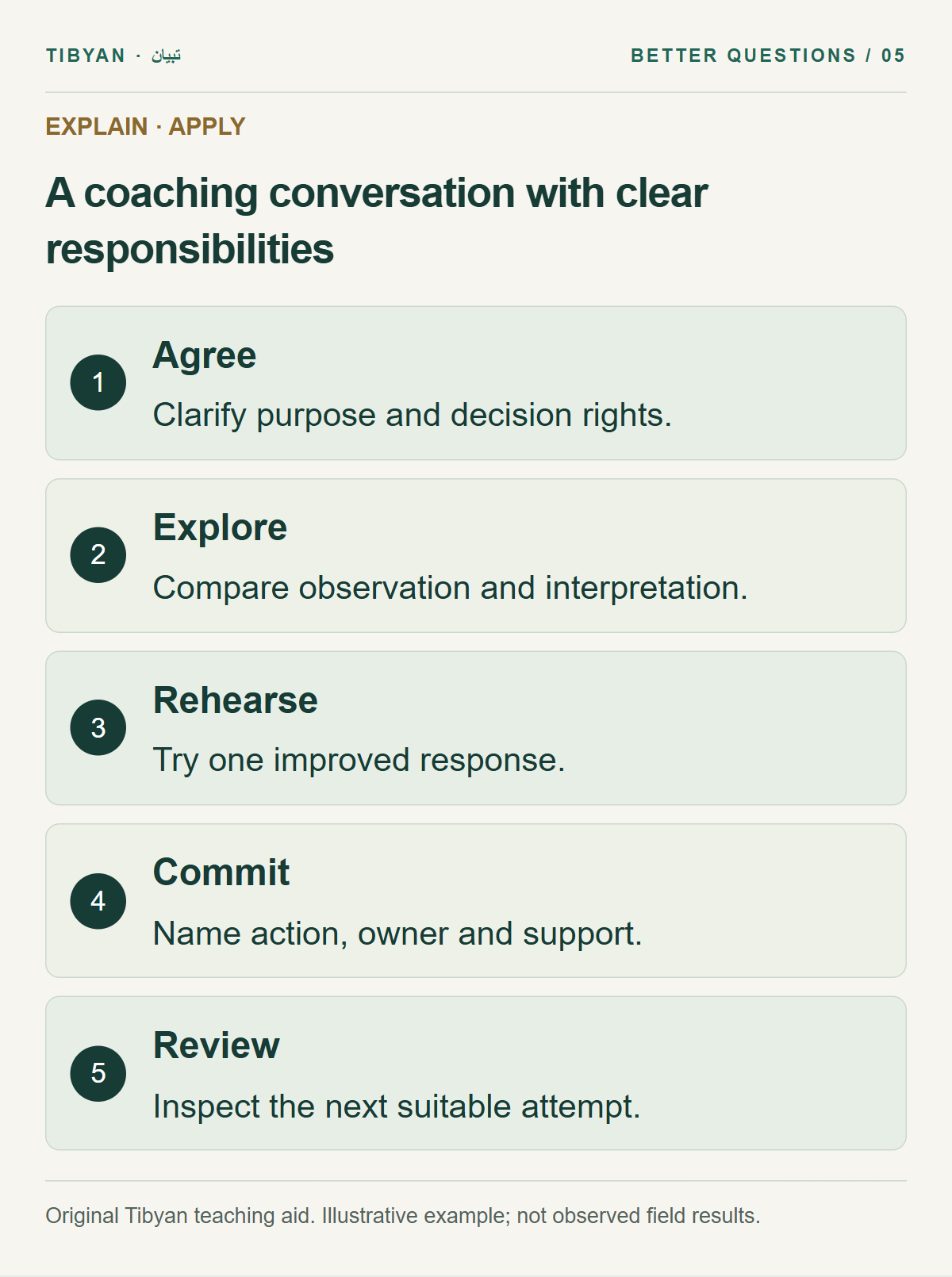
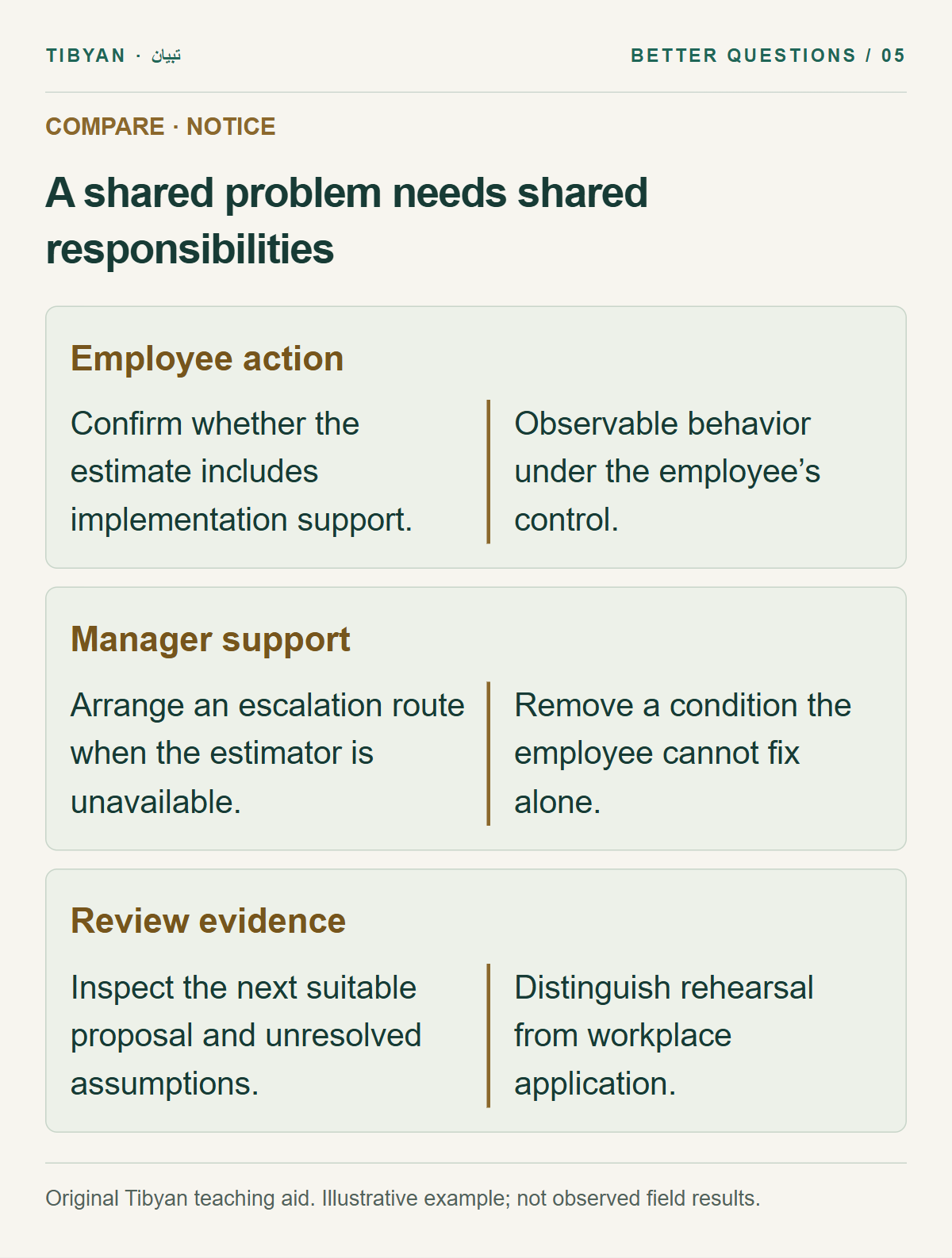
Prepare the four situation cards and show the fixed-rule case first. Ask “What can this employee actually choose?” before a coaching role-play. During rehearsal, play Omar’s unconfirmed reply; look for visible unresolved status rather than a persuasive request alone. For debrief practice, ask learners to label each line record, account or interpretation, then assign support separately from employee action. Retry with Omar unavailable so the backup arrangement matters.
Practice and retry
Classify the four situations before choosing a question. In triads, run a ten-minute coaching attempt with one rehearsal and specific feedback, then change the condition so the employee lacks the rule and requires instruction. Finish with a separate short team-debrief record using the P3 packet.
Common error and corrective feedback
Do not score agreement with the manager as learning. Do not ask the employee to reflect repeatedly when the barrier is missing authority or information. In the debrief, distinguish what the version record shows from what each participant reports.
Model feedback anchors
Conversation type and reason
Developmental coaching: Huda knows the marking requirement and can choose how to seek confirmation. The shared P3 event also needs a separate team debrief.
The record distinguishes an individual practice task from a shared process review.
Fixed requirement and genuine choices
Unresolved estimate assumptions must be visible before release. Huda can choose the communication method and propose a workable confirmation request.
The manager does not disguise a fixed requirement as employee choice.
Outcome and information agreement
Rehearse a specific confirmation request and inspect the next draft. The task note is shared with Huda, Mariam and Omar; Mariam retains release accountability.
The agreement makes the use of the conversation explicit without promising absolute privacy.
Employee’s first interpretation
Huda thought “looks fine” confirmed the support period. She had not distinguished general reassurance from confirmation of that commitment.
The interpretation is elicited before correcting it.
Rehearsed behavior and response
Huda asks whether the support period is included. When Omar says it has not been checked, she marks the item unresolved for the approver.
The rehearsal includes uncertainty rather than an unrealistically agreeable reply.
Employee action
Before the 12 November 16:00 draft, Huda sends the specific request and records the confirmation or unresolved status in the draft.
The action is observable and within Huda’s responsibility.
Manager support
Mariam establishes Lina as the backup contact and checks who may approve a revised support commitment.
Authority and access are managerial support tasks, not employee attitude problems.
Application evidence and review
At 16:30 on 12 November, Huda and Mariam inspect the draft and response record for confirmed or visibly unresolved commitments before release. Outcome not yet observed.
A planned review is not presented as a successful workplace result.
Team debrief: intended and actual event
P3 target: submission by 16:00 on 10 November. Draft history: submitted at 18:00. Huda reports scope changed at 14:30.
The event record separates a timestamp from a reported explanation.
Team debrief: conditions and unknowns
Huda identifies the scope change; Omar identifies the need for confirmation. The authority for approving the revised support period is not yet checked.
Different accounts add conditions; the record does not choose a culprit.
Team debrief: action and support owners
For the next eligible scope change, Huda records the changed assumption and response owner. Mariam confirms the authority and backup route.
The response assigns both process execution and organizational support.
Team debrief: review opportunity
At the next handoff review, compare the expected change/request/approval sequence with the actual version and response records.
The debrief ends with reviewable work rather than a general promise to communicate better.
Independent-study alternative
Classify the situation cards, write a direct instruction for the missing-knowledge case and a coaching question for the genuine-choice case. Rehearse both sides of the unconfirmed reply aloud, then complete the separate debrief fields and compare with the model.
Customer Discovery: Ask Questions That Reveal Real Needs
Open the editable working tool · Explanatory figure · Comparison/example figure
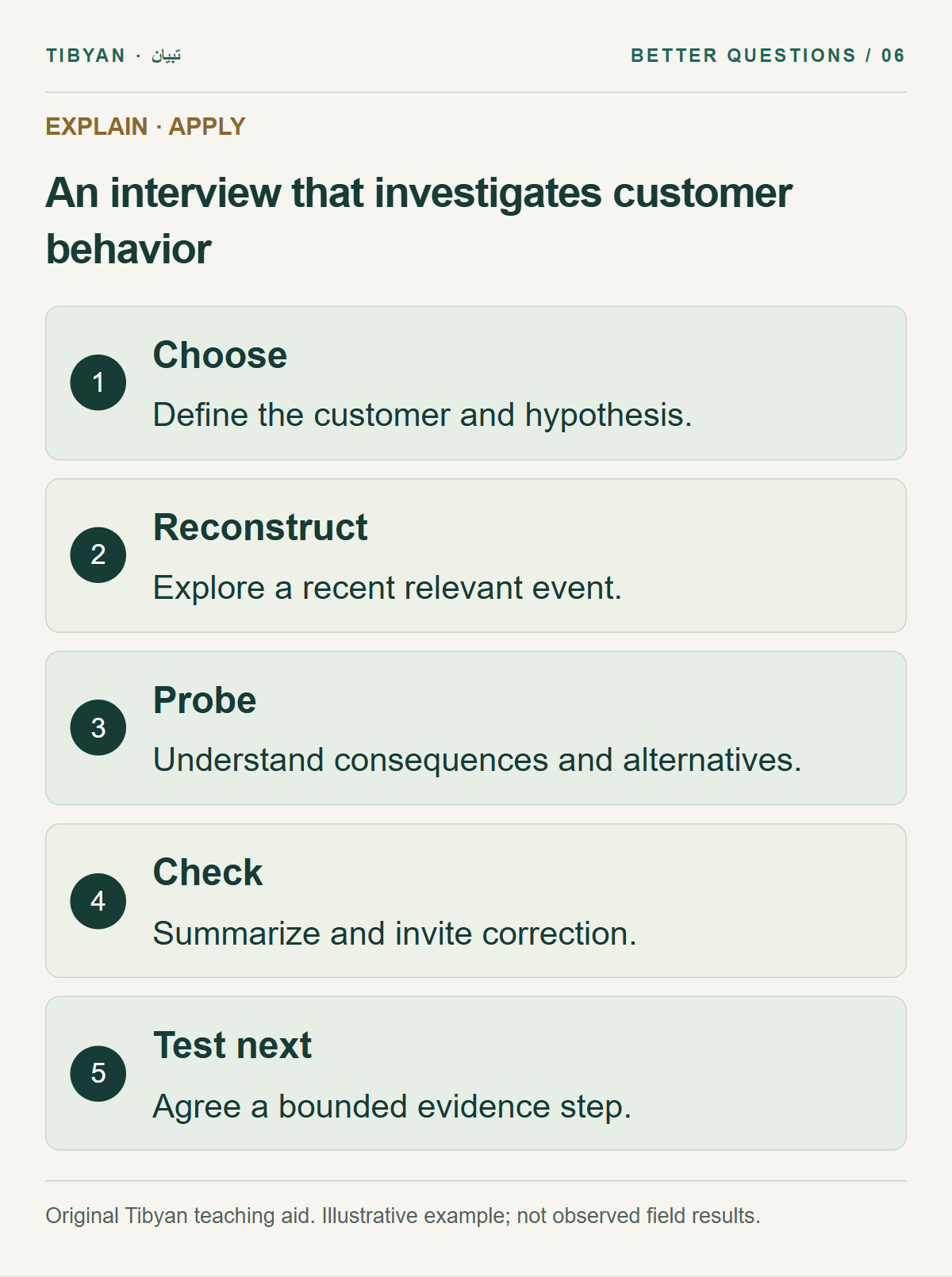
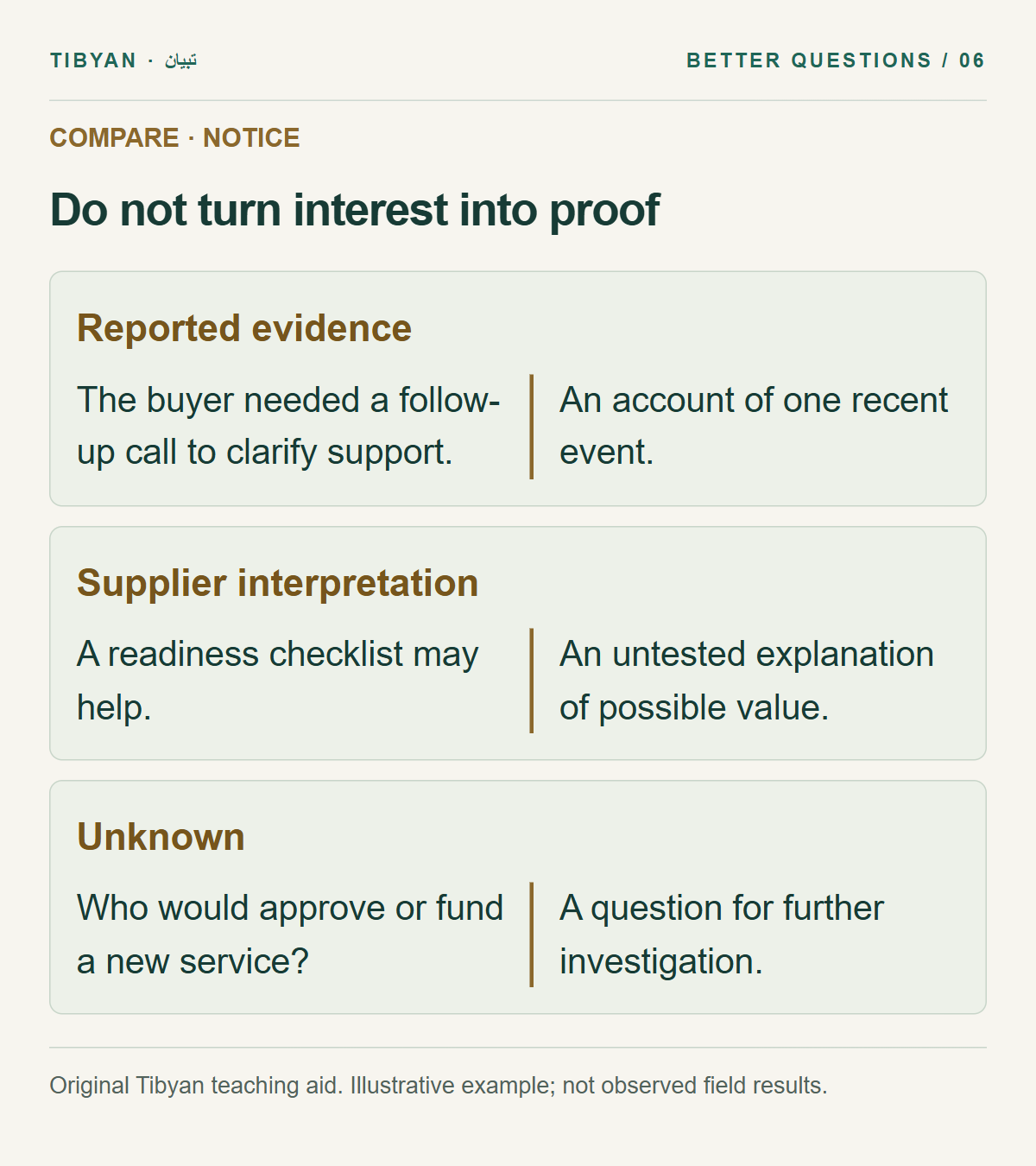
Prepare the three account cards separately. First let pairs interview using Amal’s event without showing the synthesis. Introduce Karim’s authority constraint, then Nour’s contrary account. Ask “Which part is a reported fact, which is your inference, and which remains unknown?” and “What changes in your sampling or next check?” Stop a disguised pitch and return to the recent event. For the retry, make the buyer satisfied with the current alternative; evaluate the interviewer’s neutral response rather than their ability to overcome an objection.
Practice and retry
Draft the opening and eight-stage interview guide, then conduct a ten-minute interview or use the supplied accounts. Complete three repeatable records, compare their conditions and rewrite the hypothesis. Specify one next evidence step and what it cannot establish.
Common error and corrective feedback
Do not turn “we called twice” into verified cost savings or a buying commitment. Do not erase a contrary case because its segment differs; use the difference to refine scope. A confirmed next meeting proves only that meeting, and a usable summary does not establish demand.
Model feedback anchors
Purpose, hypothesis and participant selection
Sami is exploring confirmation of implementation assumptions. Initial claim: all service buyers need clearer proposals and will buy checking. Select an operations user, a procurement coordinator and a routine-service buyer with a working alternative.
Selection tests the scope of the hypothesis rather than recruiting only likely supporters.
Interview record A — repeatable record
11 Nov 2026; Amal, operations manager, multi-party implementation. Event: 10 Nov approval needed an unspecified support period clarified. Report: “We called operations twice before the commitment was clear.” Reported consequence: one-day wait and about 30 minutes of calls. Alternative: operations calls. Interpretation: investigate confirmation. Unknown: independently checked duration and purchase intent.
The record distinguishes reported time and quotation from an established organizational measure.
Interview record B — repeatable record
11 Nov 2026; Karim, procurement coordinator. Event: 7 Nov approval took about one hour after the technical owner confirmed scope. Report: “A shorter document would not let me authorize the technical promise.” Alternative: seek owner confirmation. Interpretation: authority may matter. Unknown: process rule and who could adopt a new service.
Different roles reveal different decision constraints; a shorter form is not assumed to resolve either.
Contrary interview record C — repeatable record
11 Nov 2026; Nour, small-firm owner buying a routine service. Event: 9 Nov approval of a one-page offer using an existing checklist. Report: “I do not need another review step for this purchase.” Reported consequence: no support-commitment confusion. Interpretation: the broad segment claim is too wide. Unknown: other purchase types.
The contrary case narrows the claim without erasing a different participant’s account.
Source status and permitted next evidence
All three records are supplied fictional accounts. Within the exercise, reported wait times are not independently timed. A future real check would use a permitted non-sensitive process walkthrough, not unnecessary customer records.
No actual interview or permissioned field evidence is invented.
Cross-interview comparison
Amal and Karim both mention confirmation but occupy different roles; Karim highlights authority. Nour has a routine purchase and an adequate current checklist. Complexity and approval roles may condition the problem.
A pattern is expressed as a revisable hypothesis, not a market prevalence estimate.
Revised hypothesis and current decision
Investigate some multi-party implementation purchases requiring cross-role confirmation. Drop the claim about all service buyers; do not infer demand for a paid checking service.
The hypothesis is narrowed by both relevant and contrary accounts.
Next evidence test, owner and decision rule
Sami plans two 45-minute sessions on 12 Nov. Operations and procurement participants identify two unresolved commitments in matched fictional proposals, one current format and one summary. Reverse and record format order for the second participant. Both items must be noticed without prompting before progressing; otherwise revise. Examine added value if baseline already works. This is exploratory usability, not payment or a causal comparison.
The rule is justified by the two material commitments in this fictional task and is not a universal benchmark.
Note-taking and information boundaries
Exercise-only supplied accounts; no real participant consent or customer files exist. Permission for a future real interview has not yet been requested, so real collection remains on hold.
The completed status is honest about permission; it does not fabricate consent.
Independent-study alternative
Read account A and write your hypothesis before opening B and C. After each new account, record exactly what you retain, qualify or reject. Then create a neutral follow-up for each role and compare your synthesis with the model.
Diagnose the Problem Before Choosing a Solution
Open the editable working tool · Explanatory figure · Comparison/example figure
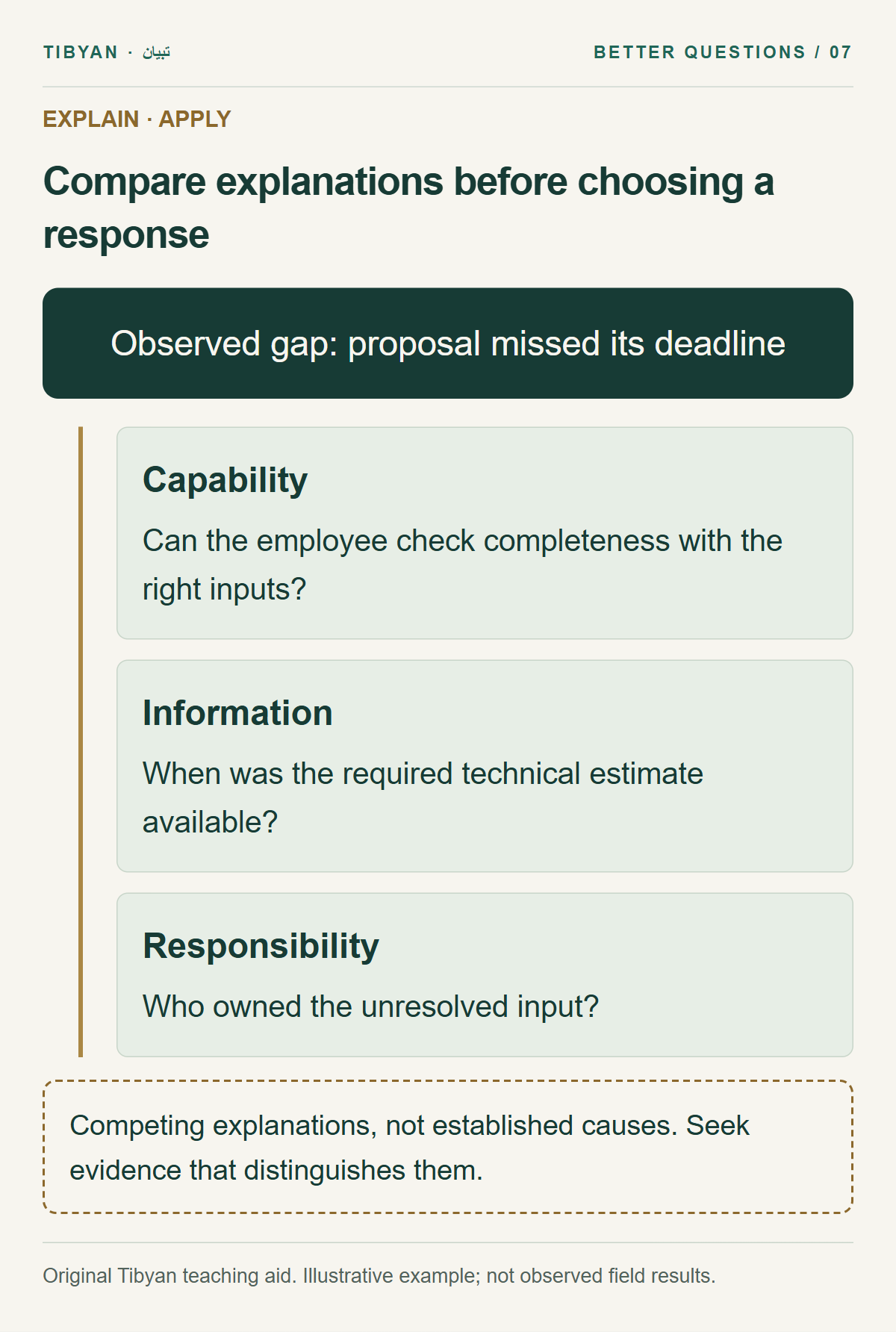
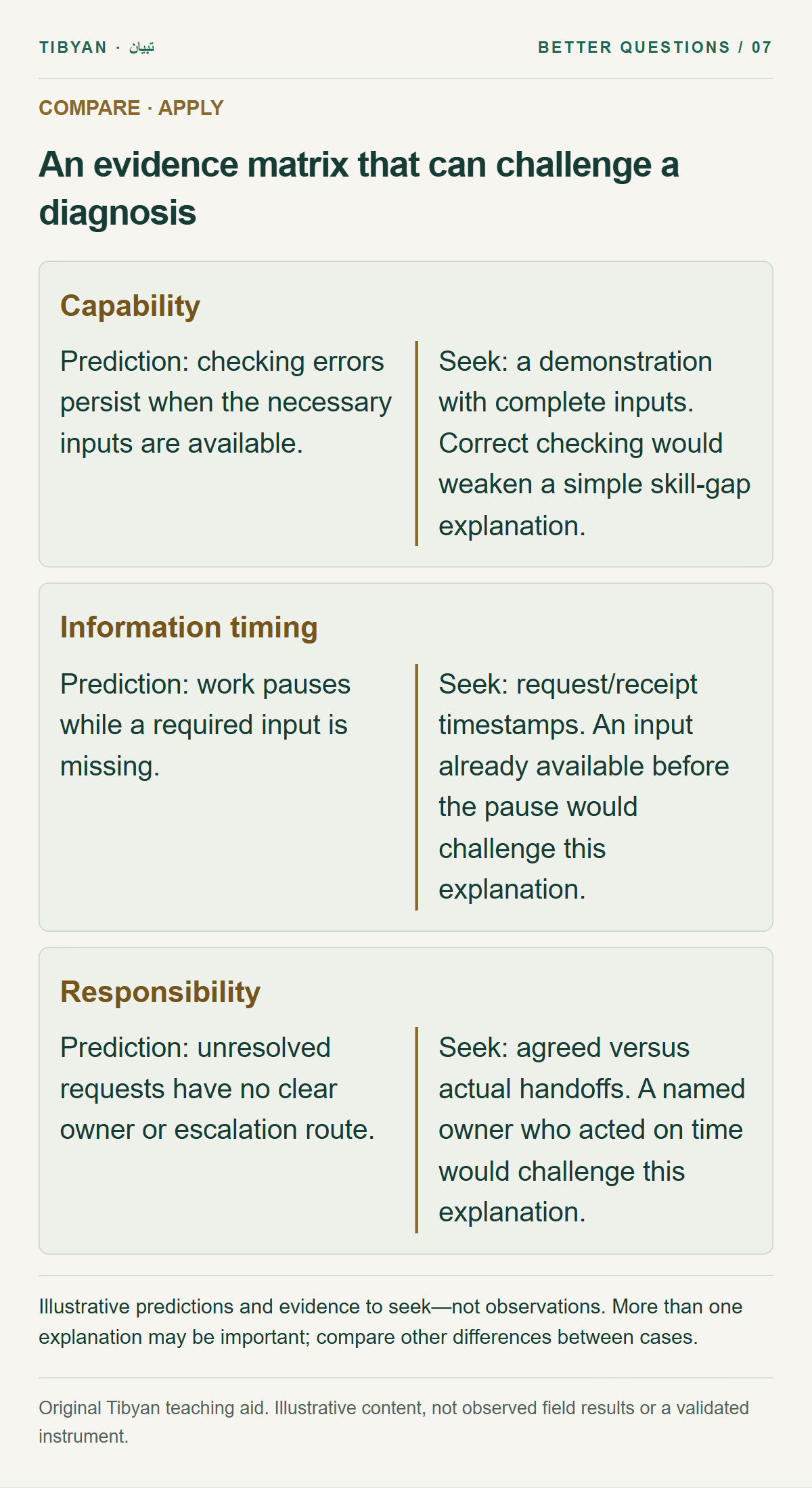
Use 5 minutes to mark facts/inferences, 10 to build predictions, 10 to compare evidence and 10 to revise after the new fact. Ask: “Which exhibit supports that sentence?” and “What different finding would change your response?” Accept training, process repair or another check only when the evidence and limits are stated. Have partners exchange matrices and challenge an empty contradiction column.
Practice and retry
Complete the matrix from E1–E4 before reading the worked decision. Then add this new fictional fact: P43’s message assigned escalation to sales, but the coordinator did not receive it. Revise one explanation and the next check; do not merely add the fact to your original conclusion.
Common error and corrective feedback
Watch for diagnosing a trait from an outcome, treating missing documentation as proof of inaction, and assuming contrasting cases differ in only one condition. A defensible alternative may retain several interacting explanations.
Model feedback anchors
Expected and observed performance
Scope and assumptions must be confirmed before issue. P41 and P43 missed their stated deadlines; P42 did not. Packet: 3–6 November 2026, fictional.
The gap uses named cases and an explicit standard; it does not estimate the company-wide delay rate.
Explanation 1: prediction, support and challenge
Capability: predict a failed completeness check with adequate inputs. Support: no direct evidence of a failed check; lateness alone is nondiagnostic. Challenge: E4 succeeded; P43 is more complex. Next: observe the extra-service check.
The late outcome is not treated as direct evidence of a skill deficit.
Explanation 2: prediction, support and challenge
Information timing: predict the estimate arrives after commitment. E1 supports this; E3 challenges timing as the sole explanation. Check completeness and change timestamps.
A supported explanation for one case need not explain every case.
Explanation 3: prediction, support and challenge
Ownership: predict unresolved items lack acknowledged escalation. P43 owner unknown because log missing. Obtain messages and compare two accounts.
The entry keeps the absence of a log distinct from the absence of responsibility.
Source/date and confounding conditions
E1–E4, fictional packet checked 11 November 2026. P43 includes an additional service; workload and approval messages remain unknown.
Named exhibits make the inference auditable; the extra service is an alternative explanation.
Next evidence check and owner
Salma retrieves P43 messages and observes the additional-service completeness check before choosing training or a process repair.
The check distinguishes support conditions from task capability.
Conditional response and review trigger
Successful check + no acknowledged escalation: test explicit ownership on three eligible proposals. Failed supported check: add targeted practice. Review at proposal 3, or before an unconfirmed issue.
Both findings lead to different, bounded actions; neither establishes a revenue effect.
Independent-study alternative
Cover the worked matrix, complete your own, then compare the predictions and uncertainties rather than matching its wording. Write one reason your first diagnosis might fail.
Use Questions to Generate Ideas and Explore Opportunities
Open the editable working tool · Explanatory figure · Comparison/example figure
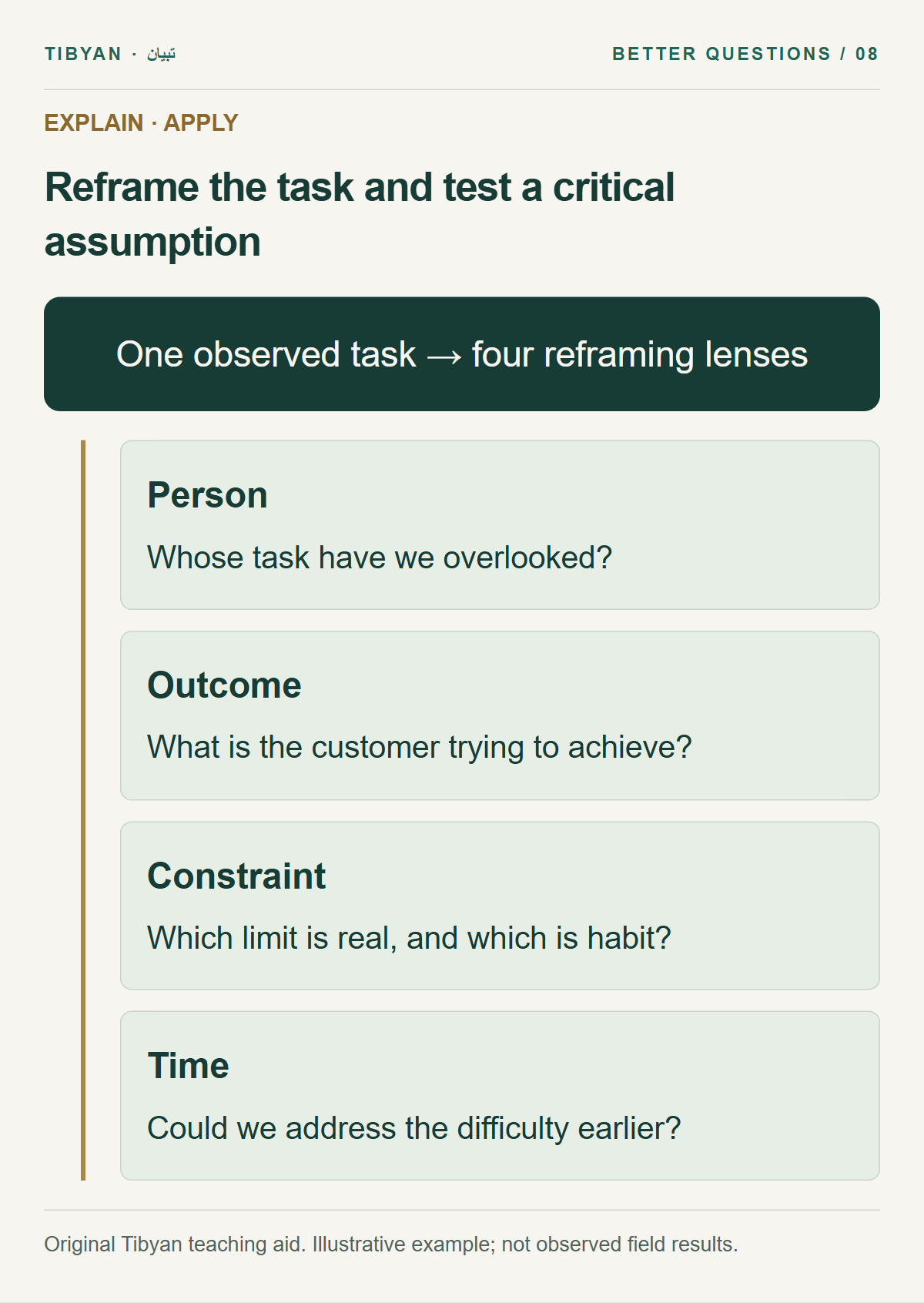
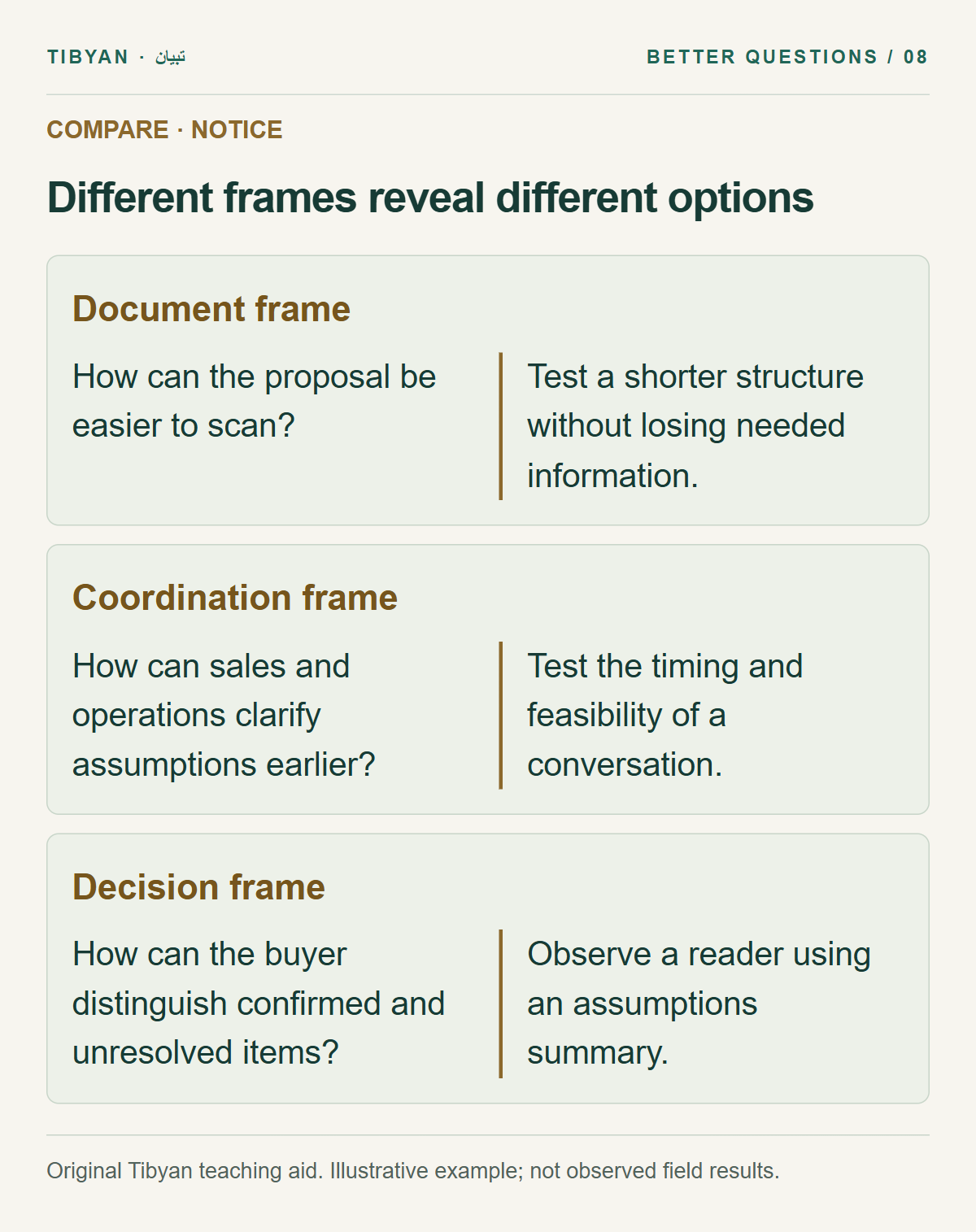
Allow 8 minutes for three frames, 7 for selecting an assumption, 10 for test design and 10 for interpreting the supplied result. Ask which observation the new frame still explains. Compare alternative decision rules on their rationale, not agreement with the example. Have learners revise the card or choose another mechanism and explain the limit of their evidence.
Practice and retry
Before reading the test result, choose a frame and write a decision rule. Then use the invented result to decide what changes. Add a new constraint: no staff time is available for an extra call. Reconsider feasibility without pretending that the constraint proves the card works.
Common error and corrective feedback
Common errors: changing the task until the favored idea wins; counting cosmetic variants as distinct mechanisms; interpreting praise as adoption; inventing a threshold after seeing the result.
Model feedback anchors
Observed user/task and limit
Two of three fictional walkthrough participants could not identify the first-week date-confirmation owner. The packet does not estimate prevalence.
The observation is specific and its sampling limit stays visible.
Frame → question → approach
Document → find the contact → revised welcome message. Coordination → confirm together → short call. Decision visibility → distinguish states → shared card.
The alternatives change how the task works, not only its wording.
Constraints and excluded frame
The team can maintain one named confirmation owner; the message must distinguish proposed from confirmed. Color preference does not address the observed ambiguity.
The rejected frame is judged against the user task, not taste.
Critical assumption and task
With the card, a new customer can identify the confirmation state, owner and next action without hints.
The assumption can be examined through observable interpretation.
Participants, materials and procedure
Dina gives three colleagues the supplied C1 card separately; each names the state, owner and action. She records errors without coaching.
This is a screening simulation; customer usability remains unknown.
Decision rule before the test
For this exercise, all three must identify state, owner and next action correctly before a small customer trial. Any commitment-state error means revise first.
A fictional screening rule is not a universal standard.
Observation, next decision and owner
Two identify all three correctly; one read proposed as confirmed. Dina revises the label and retests before approaching intended customers.
The observation leads to redesign, not a demand or rollout claim.
Limits and review trigger
No claim about payment, long-term adoption or revenue. Review immediately after retest; if interpretation is clear but workload excessive, inspect the coordination option.
The next uncertainty can shift even when the design becomes clearer.
Independent-study alternative
Use the supplied observations and write your frames before revealing the example. Read the fictional results only after committing to a rule. Record the change you made and why.
Ask Better Questions Before Making Business Decisions
Open the editable working tool · Explanatory figure · Comparison/example figure
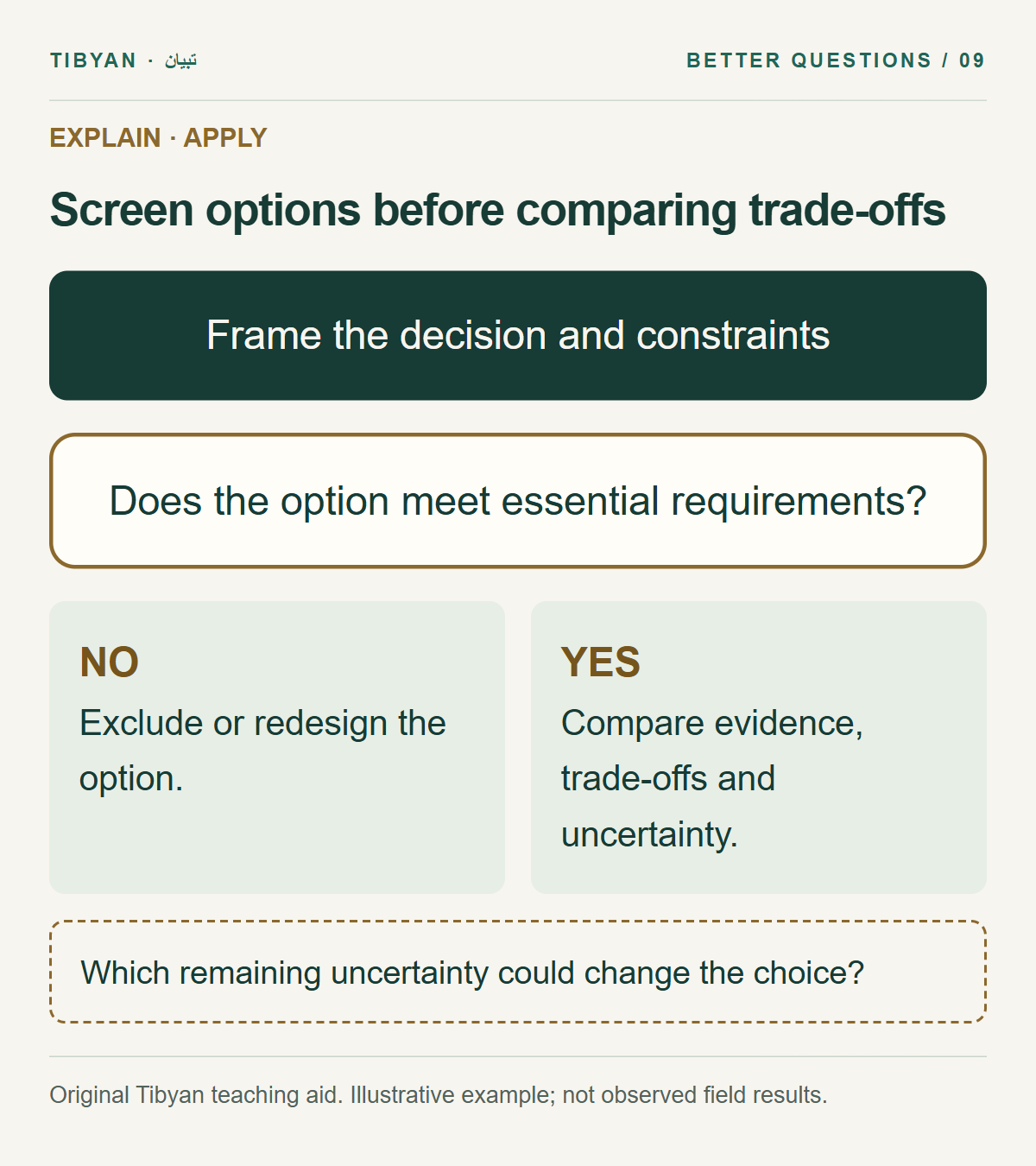
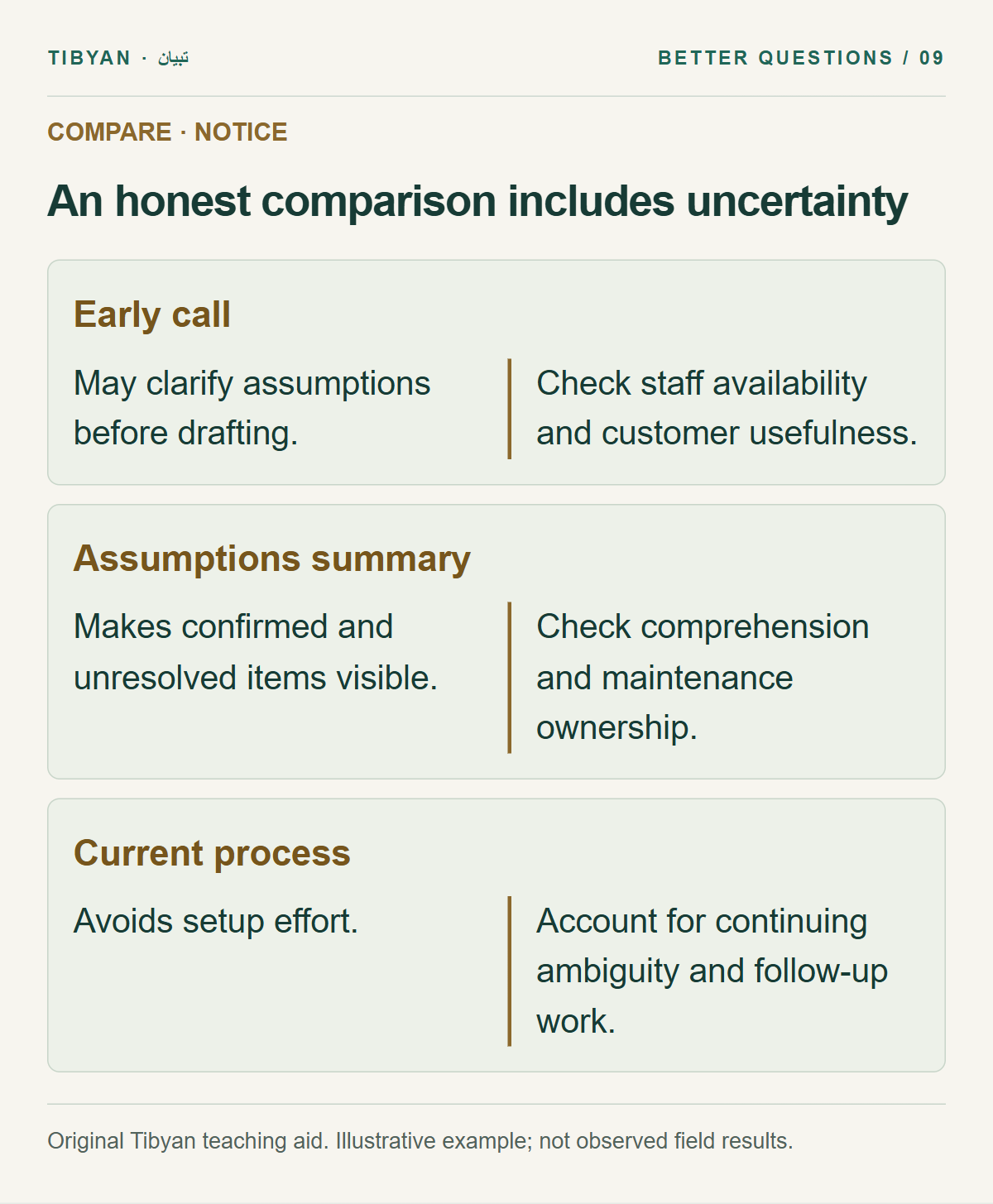
Give 10 minutes for the initial table, 5 for objections and 10 for revision after the measured-time card. Ask the learner to point to the failed requirement or reversed assumption. Accept several bounded responses, including reducing the trial scope, if the owner explicitly revises the decision and does not conceal the new resource requirement.
Practice and retry
Complete the three-option comparison, then receive a new fictional observation: preparing each summary took 14 minutes, in addition to the 10-minute setup. Recalculate 10 + 2×14 = 38 minutes, compare it with the 30-minute bound and revise the commitment. Do not keep the original recommendation unchanged by relabeling the estimate as fact.
Common error and corrective feedback
Common errors: summing scores before screening essentials; replacing “unknown” with a convenient estimate; excluding the baseline; judging the original reasoning solely from a favorable outcome.
Model feedback anchors
Decision owner, choice and deadline
Salma chooses preparation for the next two suitable approvals by 12 November 2026; this is a fictional simulation.
The entry gives the choice a boundary and accountable role.
Essential requirements and resource bound
Written confirmed/unresolved status; named maintenance owner; no more than 30 extra preparation minutes for this two-case exercise.
These requirements are fictional decision conditions, not validated standards.
Option A: requirement, evidence, trade-off and uncertainty
Call only: no written status record, so redesign before selection. It may reveal ambiguity; availability and recording effort unknown. Next: plan a call plus note.
The screen rejects the specified version, not every possible use of a call.
Option B: requirement, evidence, trade-off and uncertainty
Summary + Huda owner: prototype includes status fields. Untested estimate 10 + 2×5 = 20 minutes. Reader comprehension and actual effort require a task test.
Feasibility is provisional; the arithmetic is clear while the inputs remain estimates.
Baseline/current arrangement
Current sample has no unresolved-status label. Keep it as baseline; no reliable clarification-time measure is supplied.
Unknown costs remain unknown rather than being set to zero.
Strongest objection and decision-sensitive unknown
A reader may treat a present summary as confirmation. A status error would overturn the choice to progress toward a work trial.
The unknown bears on the decision, not merely on curiosity.
Bounded commitment and rationale
Salma selects two simulated B tasks, retains approval safeguards and records interpretation and actual preparation time. No live customer commitment follows.
The commitment buys useful evidence without implying rollout.
Review condition and next decision
Review 14 November, or immediately on a status misreading. Clear interpretation + feasible effort: small permissioned work trial. Failure: revise, rescope or compare redesigned A.
Several plausible findings produce different next actions.
Independent-study alternative
Write your recommendation and strongest objection before reading the worked note. After revealing the 38-minute result, write a second dated note explaining the change rather than erasing the first.
Use AI to Develop a Better Inquiry
Open the editable working tool · Explanatory figure · Comparison/example figure
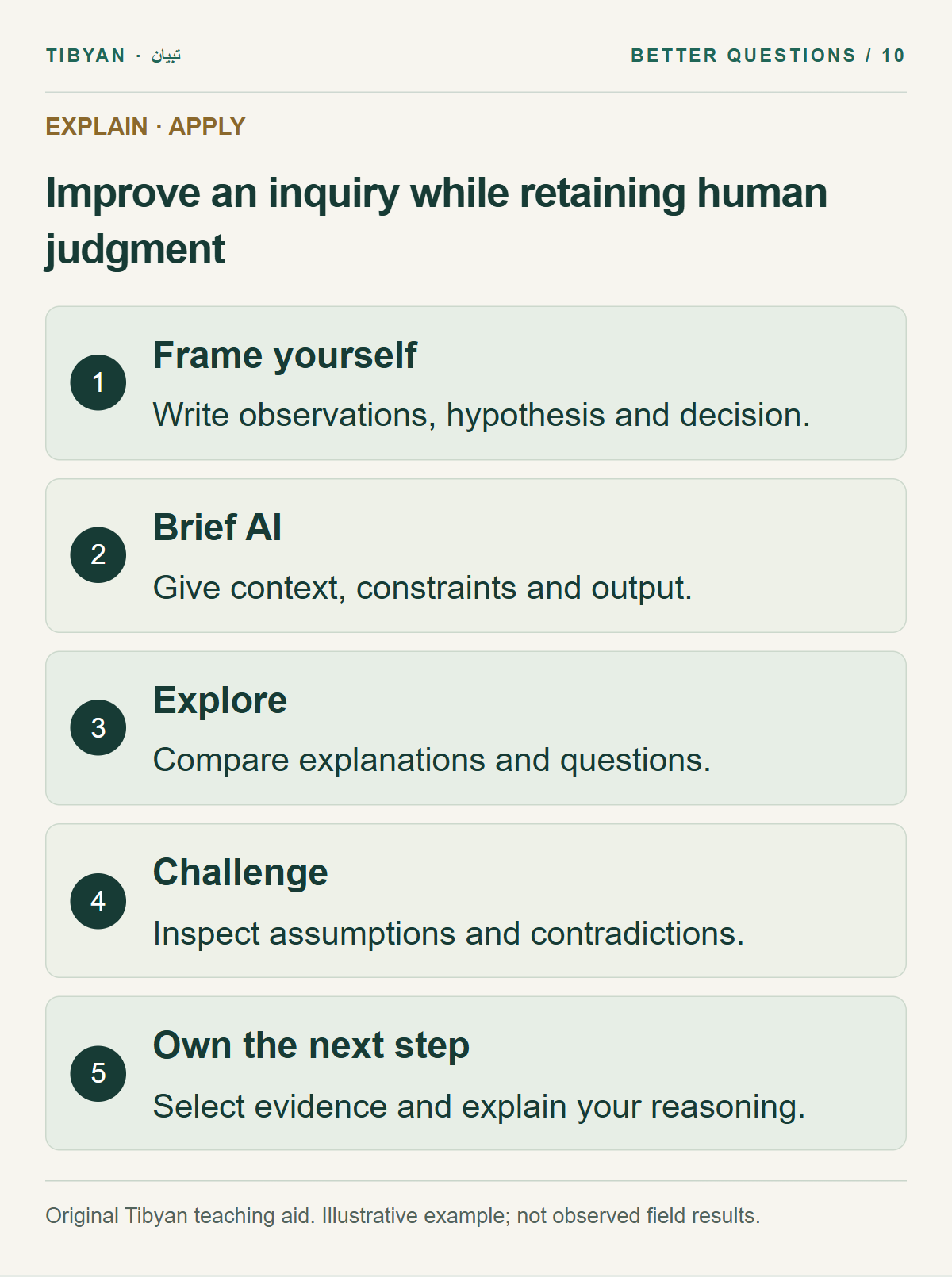
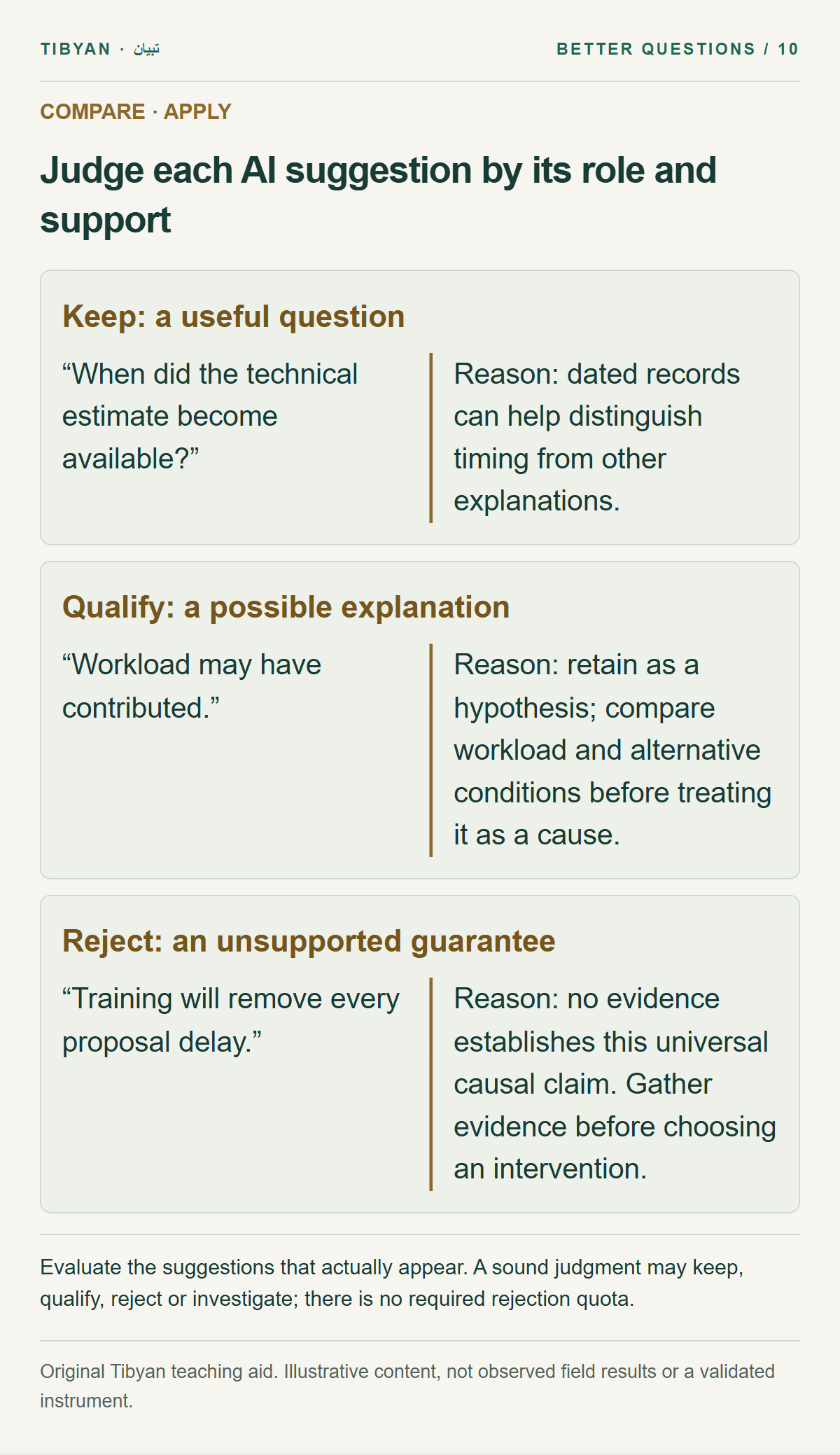
Use 5 minutes for an unaided plan, 10 for the illustrative dialogue or controlled AI use, 10 for the judgment log and 5 for an explanation with outputs closed. Ask “Which sentence changed status?” and “What evidence would you collect outside the tool?” Judge the reasons, not the number accepted or rejected. Keep the same permitted information and assistance conditions when comparing attempts.
Practice and retry
Write your own three-question plan from the fictional brief, then evaluate every consequential AI suggestion using retain/qualify/reject and a reason. Use the seeded dialogue if no AI is available. Finish with a new explanation without the transcript, and say what actual evidence is still required.
Common error and corrective feedback
Common errors: accepting a plausible explanation as a fact; rejecting a suggestion merely to meet a quota; claiming that a better-written prompt guarantees reliable reasoning; judging learning only by the polished assisted plan.
Model feedback anchors
My plan before AI
I initially suspect poor planning and ask which course to buy. The cause is not established.
The original assumption is preserved so change can be inspected.
Permitted facts, hypotheses and unknowns
Fictional facts: P41 and P43 were late; P41’s estimate arrived after its deadline; P43’s approval log is missing. Hypothesis: planning. Unknowns: completeness, ownership, capability and motivation. No confidential client data supplied.
The brief does not quietly promote a hypothesis to fact.
Useful turns and human challenges
I asked the AI for the evidence behind motivation, required competing predictions and challenged the equation of a missing log with absent ownership.
Human challenges target specific unsupported inferences.
Suggestion → judgment → reason → next check
“Lateness shows low motivation” → reject as diagnosis → no supporting fact → avoid employee label; examine only if later evidence warrants it.
Rejection concerns the inference; it does not prove motivation irrelevant in every case.
Suggestion 2 and judgment
Request/receipt timing → retain → a dated trail could alter the intervention → obtain the relevant messages and check whether inputs were complete.
A useful question is retained as a question, not accepted as a causal answer.
Suggestion 3 and qualification
No log means no owner → qualify → log missing, ownership unknown → ask who held responsibility and how the request was communicated.
Qualification keeps a testable uncertainty without repeating the AI assumption.
Revised inquiry and owner
Salma retrieves P43 messages, checks responsibility/communication with both roles, then observes a supported completeness check if the gap remains unexplained.
The plan sequences checks rather than repeating a list of topics.
Independent explanation and remaining uncertainty
The handoff trail could change whether we repair communication or provide practice. Neither motivation nor a skill deficit is established.
The learner must justify the next step, not reproduce fluent AI language.
Assistance record and review point
Teaching dialogue authored by Tibyan, revised 11 November 2026; no model benchmark claimed. Salma reviews the retrieved trail before an intervention is approved.
The provenance distinguishes an illustration from an observed model interaction.
Independent-study alternative
Use the authored AI response as a critique exercise. Annotate facts, hypotheses and unjustified conclusions, then write a revised brief and a next evidence step. This does not require access to a model.
Question AI’s Answers and Verify the Evidence
Open the editable working tool · Explanatory figure · Comparison/example figure
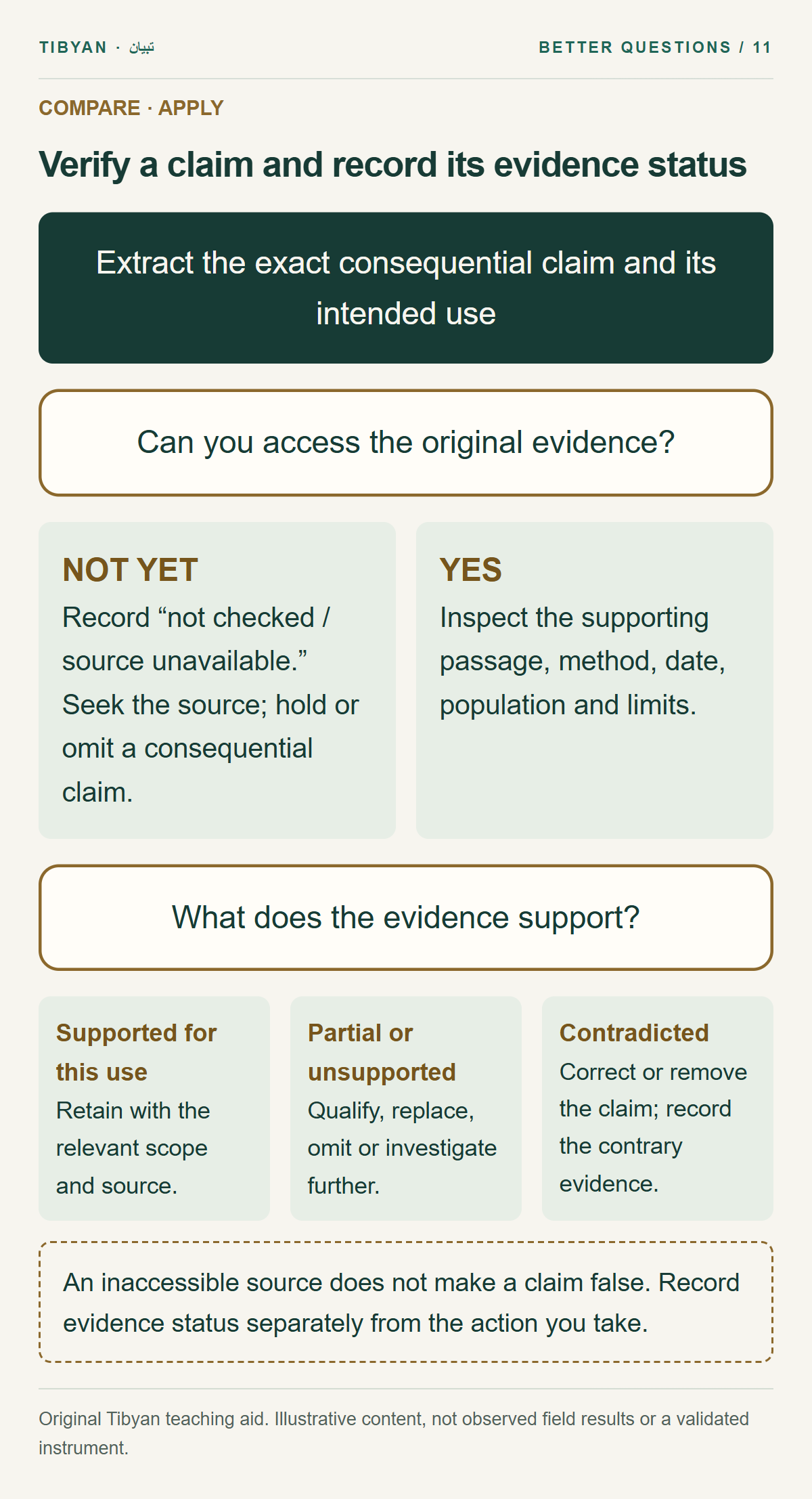
Allow 10 minutes for exact claims and prioritization, 15 for source/calculation checks and 10 for rewritten statements and peer repetition. Ask “Show the supporting passage or mark it inaccessible,” “Which denominator did you use?” and “What evidence status differs from your action?” The three seeded claims permit feedback; do not present the exercise as a validated verification test.
Practice and retry
Complete all three claim records without viewing the answer column. Open the real Lee source for claim 1; recalculate claim 2 from the supplied fictional counts; mark claim 3 honestly when its source is unavailable. Rewrite the draft and have a partner repeat one check from your locator.
Common error and corrective feedback
Common errors: accepting an institutional logo instead of checking support; using one denominator for two periods; confusing relative percent change with percentage points; calling an inaccessible source disproved; asking another AI for certainty instead of obtaining evidence.
Model feedback anchors
Intended use and consequence
A public teaching explanation about AI and a checklist; inaccurate causal claims or percentages could mislead readers.
The level of checking follows the intended use.
Claim 1: exact original sentence
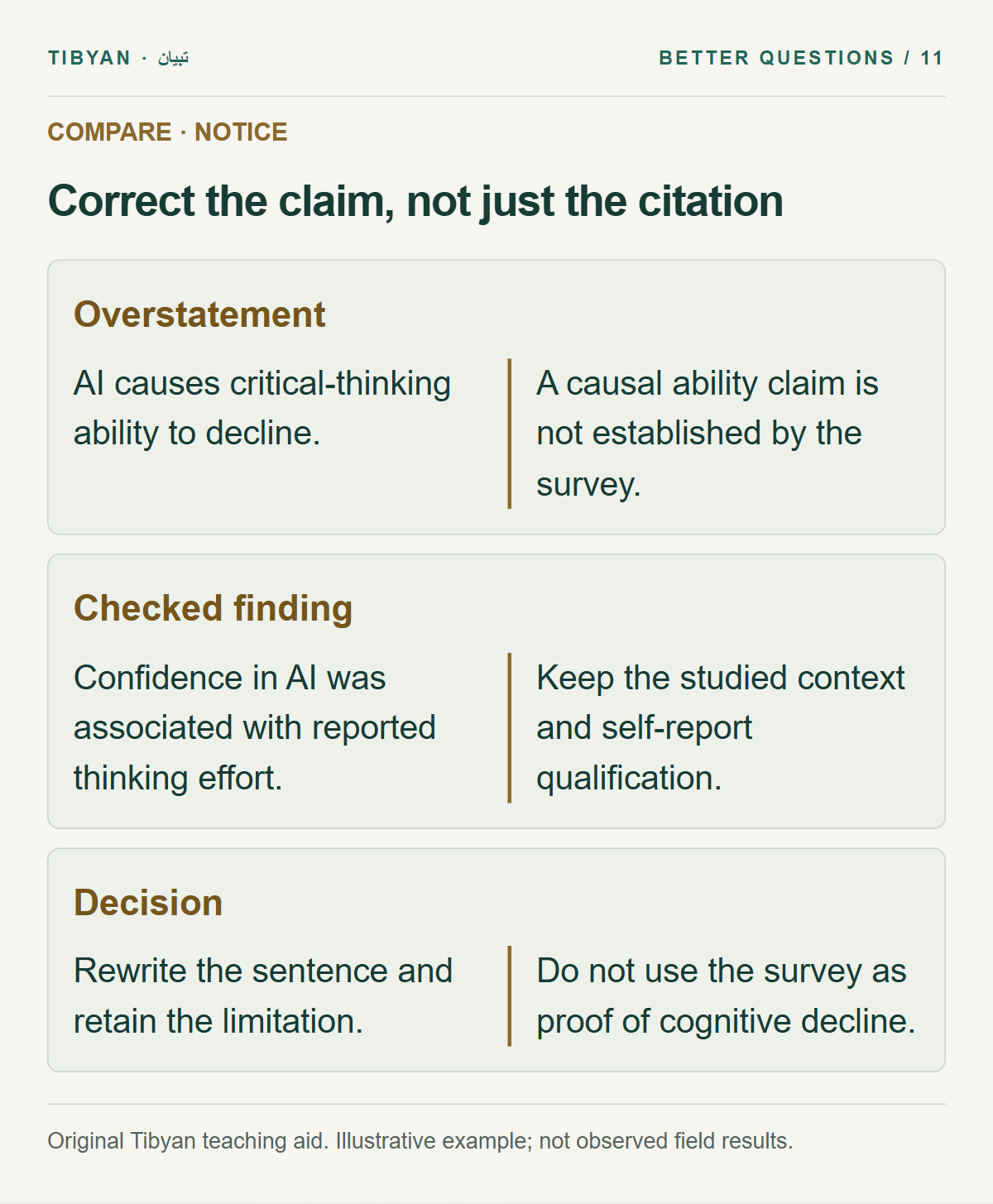
“Research proves that AI reduces workers’ critical-thinking ability.”
The exact causal and ability wording is available for inspection.
Claim 1: source/title/date/locator
Lee et al., 2025, The Impact of Generative AI on Critical Thinking. Original publication page, quantitative/qualitative summary paragraphs. https://www.microsoft.com/en-us/research/publication/the-impact-of-generative-ai-on-critical-thinking-self-reported-reductions-in-cognitive-effort-and-confidence-effects-from-a-survey-of-knowledge-workers/
The locator lets a second reader repeat the check.
Claim 1: support, method and applicability
Survey/self-report association; causal ability decline not established.
The claim is appraised at its actual strength.
Claim 1: status and revised wording
Unsupported causal claim. Replacement: “Greater AI confidence was associated with lower self-reported thinking effort in the surveyed tasks; causal ability decline was not established.”
This is a qualified use of the source, not confirmation of the original claim.
Claim 2: exact claim, inputs and source
“Our clarification rate fell by two percentage points after the checklist.” Fictional before record: 8/40; after record: 6/50; different task mixes, no comparison group.
Both denominators are retained; the fictional dataset is not presented as research.
Claim 2: reproducible calculation and uncertainty
8/40=20%; 6/50=12%; 20−12=8 percentage points; 8/20=40% relative decline. Task differences prevent causal attribution.
The calculation can be checked independently and its limit is explicit.
Claim 2: status and actual replacement
Contradicted numerically. Replace with: “The fictional rates were 20% and 12%, eight percentage points apart; the record does not isolate a checklist effect.”
The replacement fixes the arithmetic without overclaiming.
Claim 3: exact claim and accessible source
“An unspecified report proves this checklist doubles every team’s productivity.” No author, title or URL supplied.
The sentence is intentionally fictional; no real report is being alleged.
Claim 3: evidence status and disposition
Not checked/source unavailable. Omit from the recommendation; seek an appropriate accessible source before reconsidering.
Omission is justified by insufficient support, not proof of falsehood.
Checker, check date, unresolved items and release decision
Fictional teaching reviewer; 11 November 2026. Claims 1–2 rewritten; claim 3 held. An actual publication still requires checking the retained statements and links.
The exercise does not impersonate human approval or a completed real-world audit.
Independent-study alternative
Use the three supplied claims. Check the real source if online access is available; if not, mark claim 1 not checked and complete the arithmetic and source-unavailable records. Reopen the real source later before treating the corrected research sentence as verified.
Build a Lasting Questioning Practice
Open the editable working tool · Explanatory figure · Comparison/example figure
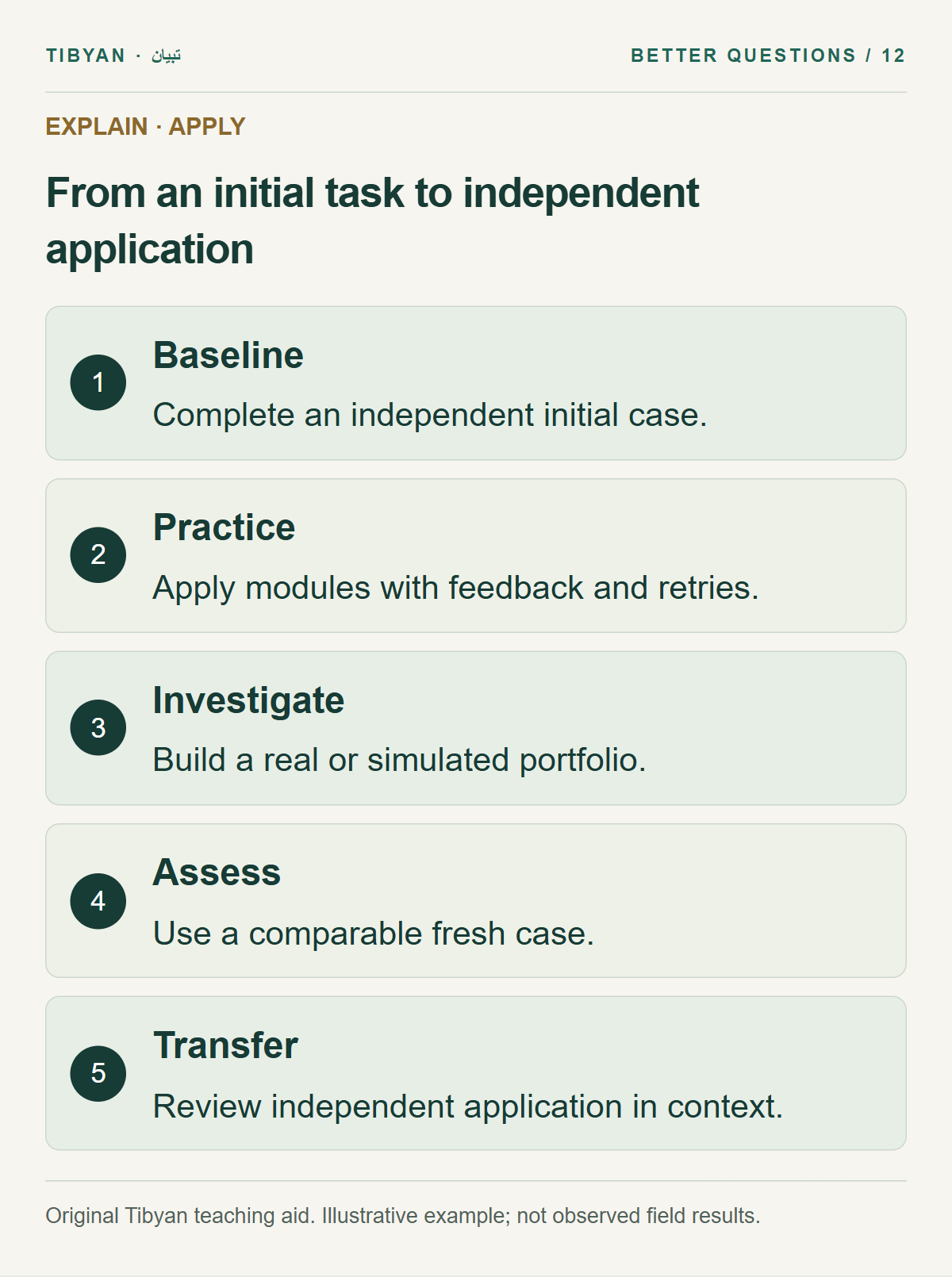
Begin the initial 20-minute assessment before instruction and schedule its respondent interaction separately. Assign capstone evidence collection between sessions after module 7; use module 12 for a portfolio review and a fresh final task, not for claiming completed workplace fieldwork. Use scored calibration samples before rating learners, retain disagreements and offer a targeted retry. Follow application only after an appropriate real opportunity.
Practice and retry
Complete a portfolio from the supplied simulation or a permitted real task. Label the evidence type. Add the question that changed your interpretation, a discarded question, the exact next action and an observation/review condition. Complete the final assessment separately under the same assistance conditions as the initial task.
Common error and corrective feedback
Common errors: a polished hindsight story with no initial view; treating a plan as an observed action; scoring supported practice as independent skill; using a pre/post difference to claim that the course caused business impact.
Model feedback anchors
Decision, owner and initial assumptions
Salma chooses the next response to proposal delay. Rana initially suspects planning and asks which course to buy; this remains an assumption.
The portfolio makes the initial premise open to challenge.
Actual questions and discarded question
Discarded: “Which course?” Revised: what happened in P41/P43; when did inputs arrive; who received ownership; how was receipt acknowledged; what could contradict this account?
The sequence opens alternatives before selecting the remedy.
Evidence records and locators
E1–E4 from module 7; F1 undelivered assignment copy; F2 missed support ambiguity; F3 three-case trial. All records are explicitly fictional.
The record can be checked without mistaking invented teaching data for a field case.
New information and revised interpretation
F1 weakens “no owner” and raises unconfirmed communication; F2 identifies a specific checking gap. Planning is not established as the sole cause.
The learner revises the explanation rather than only adding information.
Action, owner and support
Salma organizes acknowledged handoffs and an escalation route. Rana rehearses the support-coverage check with feedback and flags unresolved items before issue.
Manager support and learner practice have distinct owners.
Review date/condition and actual follow-up
At case 3, F3 shows all unresolved assumptions marked; two cases timely, one late after changed scope. Reopen immediately if a commitment is misread.
The fictional follow-up includes an exception and a review condition.
Assistance and independent demonstration
F2 was supported practice. Rana’s next independent coverage check remains to be observed; no independent proficiency score is inferred from the trial.
The portfolio leaves an unobserved outcome unclaimed.
Five-dimension profile and feedback
Profile status: not rated. No standardized independent learner response and live interaction are supplied for this fictional portfolio. The five judgments remain unassigned; the scored calibration packet is a separate practice asset.
The example is not a pre-awarded score or a certification.
Learning, application and impact limits
F3 is fictional simulation data; the combined change cannot identify which element mattered. No real transfer or business impact is claimed.
This protects the difference between demonstration, observation and effect.
Next practice opportunity and review partner
Rana will record one answer-dependent follow-up in the next suitable approval discussion and review it with Dina. If no opportunity occurs, record that and choose another suitable task.
The plan specifies an opportunity rather than promising a universal schedule.
Independent-study alternative
Use the fictional exhibits and assessor cards in self-study order: attempt, record your answer, reveal new information, revise, then compare with calibration. Self-scoring is formative reflection; it is not an independent rater judgment or proof of transfer.
Initial and final independent tasks
Learner instructions — same for both forms
Use only the supplied packet, ordinary writing tools and the live respondent. No AI, outside research, colleague advice or worked answer during the independent assessment. A reasonable accessibility accommodation may be agreed in advance; record it and keep the assistance conditions comparable across attempts.
20-minute task: minutes 0–12: name the decision and constraints; separate observations from assumptions; write five questions in a useful sequence; compare at least two explanations and their predictions; select the next evidence and a provisional action. Minutes 12–16: conduct the scripted respondent conversation. Minutes 16–20: revise your record after the conversation, noting what changed and why. The respondent is a role-play partner, not an adviser.
Submit the initial and revised record, the question that responded to new information, source/exhibit references, the next action and owner, remaining uncertainty and a review condition. There is no required favorite solution. Do not diagnose an employee's character from a delay.
Take the initial task before reading the learning pathway. Use the other form after practice and feedback. The packets are designed to be comparable, but equivalence has not been established; pilot timing and difficulty before interpreting score differences. Report five dimensions separately. A pre/post change alone does not isolate an effect of the course.
Solo self-study variant
Without a respondent, complete and retain the written phase first. Then open the scripted new fact, record what it changes and revise without another person's help. Mark responsive listening “not observed / not assessed”; a written adaptation is not evidence of live listening. This solo variant is not directly comparable with the live initial/final administration. If both attempts use the solo variant, report only the four written dimensions and record the assistance conditions; do not invent a listening score.
Case A: complete before studying the worked examples
Form A — proposal readiness
Fictional scenario. All people, dates, documents and statements are invented for this assessment. A small service firm, Namaa, has late proposals. Operations manager Salma must choose the next response for two suitable proposals by 12 November 2026, 10:00. She can authorize up to ten extra checking minutes per proposal for this bounded exercise; no larger intervention has been approved.
Terms: a technical estimate states the planned work and assumptions. Support coverage means the hours and activities the supplier would support after installation. Receiving a document does not necessarily confirm every item in it.
A-S · Agreed working standard
Before a proposal is issued, scope and support commitments must be confirmed, or clearly marked unresolved for the authorized approver. The coordinator prepares the record; the estimator confirms technical content; Salma owns escalation if a required item cannot be confirmed.
A-T · Event record
| Case | Customer deadline | Technical estimate received | Recorded outcome |
|---|---|---|---|
| A-11 · standard service | 2 November, 15:00 | 2 November, 16:00 | Proposal late. |
| A-12 · standard service | 4 November, 15:00 | 3 November, 11:00 | Proposal on time. |
| A-13 · additional service | 6 November, 15:00 | 5 November, 11:00 | Proposal late; confirmation field blank. |
The packet contains no complete request-time or workload log. It does not establish the firm's overall lateness rate.
A-I · Two stakeholder accounts
- Coordinator Rana: “Planning helps, but some inputs are not ready when the deadline is promised. For A-13 I had the estimate before the deadline.”
- Estimator Omar: “Some requests reach me after the customer date has already been set. I cannot tell from this table which items the coordinator considered complete.”
These are attributed accounts, not verified causes.
A-M · Message fragment
An internal message on 5 November, 12:00, says: “Use the current version; the remaining questions can follow.” The excerpt does not identify the remaining questions or demonstrate who accepted responsibility for them.
A-X · What is not yet available
The full A-13 confirmation exchange is not in the written packet. A respondent playing Rana can answer questions using an assessor-only card. Do not invent timestamps or treat an empty field as proof that nobody acted.
Case B: fresh final task
Form B — onboarding handoff
Fictional scenario. All people, dates, documents and statements are invented for this assessment. A small service firm, Riwaq, has late handoffs from onboarding to installation. Operations manager Mazen must choose the next response for two suitable handoffs by 12 November 2026, 10:00. He can authorize up to ten extra checking minutes per handoff for this bounded exercise; no larger intervention has been approved.
Terms: a setup pack lists the work and conditions needed before installation. A site-access slot is the time the customer confirms the installation team can enter the location. Receiving a pack does not mean every condition has been confirmed.
B-S · Agreed working standard
Before the handoff is issued, scope and site-access commitments must be confirmed, or clearly marked unresolved for the authorized approver. The coordinator prepares the record; the site contact confirms access; Mazen owns escalation if a required item cannot be confirmed.
B-T · Event record
| Case | Installation handoff deadline | Setup pack received | Recorded outcome |
|---|---|---|---|
| B-11 · standard setup | 2 November, 15:00 | 2 November, 16:00 | Handoff late. |
| B-12 · standard setup | 4 November, 15:00 | 3 November, 11:00 | Handoff on time. |
| B-13 · additional location | 6 November, 15:00 | 5 November, 11:00 | Handoff late; confirmation field blank. |
The packet contains no complete request-time or workload log. It does not establish the firm's overall handoff-delay rate.
B-I · Two stakeholder accounts
- Coordinator Hadi: “Planning helps, but some conditions are not confirmed when the date is promised. For B-13 I had the setup pack before the deadline.”
- Site contact Leila: “Some requests reach me after the installation date has already been set. I cannot tell from this table which conditions the coordinator considered complete.”
These are attributed accounts, not verified causes.
B-M · Message fragment
An internal message on 5 November, 12:00, says: “Use the current version; the remaining questions can follow.” The excerpt does not identify the remaining questions or demonstrate who accepted responsibility for them.
B-X · What is not yet available
The full B-13 access-confirmation exchange is not in the written packet. A respondent playing Hadi can answer questions using an assessor-only card. Do not invent timestamps or treat an empty field as proof that nobody acted.
Respondent role cards and delivery protocol
Assessor/respondent only — Form A
Play Rana. Start with: “I had the estimate before the deadline, so I do not think another general planning course answers everything.”
If asked what “had the estimate” meant, what remained unresolved, or what happened between receipt and approval, disclose the new fact: support coverage for the additional service was not confirmed. Rana asked on 5 November at 12:00; the confirmation reply arrived on 6 November at 16:00, after the 15:00 deadline. These exact times are invented assessment facts.
If asked who owned it, say: “The general standard gives Salma escalation responsibility, but this packet does not show who accepted this particular follow-up.” If asked about workload or ability, say no reliable record or demonstration is supplied. If asked to correct a summary, confirm only the stated facts and correct any assertion that motivation, absent ownership or inability is established.
Do not reward a preferred solution, volunteer advice or improvise evidence. If the learner has not elicited the new fact by the second minute of the conversation, disclose it using exactly the same wording. Record whether the learner elicited it or received the standard disclosure. Everyone should have a chance to respond to the same fact; judge responsive use of it, not only whether a particular phrase unlocked it.
Assessor/respondent only — Form B
Play Hadi. Start with: “I had the setup pack before the deadline, so I do not think another general planning course answers everything.”
If asked what “had the pack” meant, what remained unresolved, or what happened between receipt and handoff, disclose the new fact: the site-access slot for the additional location was not confirmed. Hadi asked on 5 November at 12:00; the confirmation reply arrived on 6 November at 16:00, after the 15:00 deadline. These exact times are invented assessment facts.
If asked who owned it, say: “The general standard gives Mazen escalation responsibility, but this packet does not show who accepted this particular follow-up.” If asked about workload or ability, say no reliable record or demonstration is supplied. If asked to correct a summary, confirm only the stated facts and correct any assertion that motivation, absent ownership or inability is established.
Do not reward a preferred solution, volunteer advice or improvise evidence. If the learner has not elicited the new fact by the second minute of the conversation, disclose it using exactly the same wording. Record whether the learner elicited it or received the standard disclosure. Everyone should have a chance to respond to the same fact; judge responsive use of it, not only whether a particular phrase unlocked it.
Administration, calibration and timing
- Before instruction, assign one form, preserve the unedited initial response and use the 20-minute protocol. Keep respondent cards hidden until the conversation; a self-study reader should attempt the task before opening them.
- Use the same information access, timing, respondent procedure and assistance conditions for the other form after learning. If accommodations or technical problems change conditions, record them. Do not make an unqualified score comparison.
- Before rating learners, two reviewers score all three complete calibration responses independently, then compare dimension scores and cite the exact sentence or turn behind each judgment. Discuss disagreements; revise ambiguous anchors, not a learner's response to fit a favorite solution.
- Score the written record together with the conversation. If a dimension could not be observed because administration failed, mark “not observed” and obtain evidence rather than silently converting missing opportunity to zero. When the learner is observed ignoring an answer, that is evidence for the relevant anchor.
- Retain the first scores, disagreement, reason and reconciled judgment. Keep the five-dimension profile; do not set a certification cut score or label a person a good/bad thinker.
- Scheduling example: initial assessment before Session 1; instruction and practice across six paired sessions; capstone evidence collection after module 7 between sessions; final 20-minute assessment and portfolio review as additional scheduled time after Session 6. A real investigation needs appropriate access and time outside the classroom.
- Give one evidence-specific feedback point and a fresh retry. Report improvements on the tasks with their conditions; do not attribute a pre/post difference to the course alone.
Complete calibration responses
Sample 1 · unsupported diagnosis
Written response: “Rana lacks planning skills. Salma should buy a time-management course next week. A-11 and A-13 were late, which proves the cause. My questions are: Why does Rana leave things late? Why does she not prioritize? Why ignore the deadline? Which course will help? Would automation force her to finish?”
“I do not need to inspect the messages because the outcome is clear. Salma will send Rana to training and later ask whether deadlines improved.”
Conversation excerpt: Rana says she received the estimate early. The learner replies, “Then you had everything; you need to plan better.” At the standard disclosure, Rana explains that support coverage remained unconfirmed until after the deadline. The learner responds, “That still proves planning is the issue.”
Final record: “Keep the course recommendation. The employee's explanation is an excuse.” No source correction, revised question or contrary evidence is recorded.
| Dimension | Score | Reason for judgment |
|---|---|---|
| Framing | 0 | The response treats a selected cause as fact instead of framing a choice within the constraint. |
| Question relevance and sequence | 0 | The questions embed the preferred diagnosis and do not investigate useful alternatives. |
| Responsive listening | 0 | The learner ignores the new fact and imposes an interpretation. |
| Evidence judgment | 0 | Two selected outcomes are treated as proof; the timely case, source limits and new fact are dismissed. |
| Action and reflection | 1 | A manager and action are named, but support, a usable review condition and a justified link to evidence are missing. |
Feedback: Ask the learner to replace the trait judgment with the observed gap, cite A-T without claiming a population rate, and write one question about what the early estimate did not contain. A different recommendation is not enough; the reasoning must change.
Retry: Give the learner A-M again. Ask what the message does and does not establish, then allow a new inquiry plan.
Sample 2 · developing inquiry
Written response: “We need to choose whether to improve information flow or provide practice. I would ask: What happened in A-13? When did the estimate arrive? What did it include? Who approved it? Would a checklist help?”
“A-11 supports an information-timing explanation. A-13 might be an ownership problem because the confirmation field is blank. I would inspect the message trail. I have not checked workload.”
Conversation excerpt: Rana repeats that the estimate arrived early. The learner asks, “Was something missing?” Rana discloses the unconfirmed support coverage and late reply. The learner says, “So it was incomplete. Was that raised with anyone?” Rana says the packet does not show who accepted the follow-up. The learner moves on without checking the summary.
Final record: “Use a checklist on the next two proposals and get Salma to review whether it helps. We now know information was incomplete in A-13; ownership still needs checking. A skill gap is also possible, but I have not stated what evidence would distinguish it.”
| Dimension | Score | Reason for judgment |
|---|---|---|
| Framing | 1 | A real choice is named, but the decision deadline and resource limit are not incorporated. |
| Question relevance and sequence | 1 | Several questions are useful, but the last jumps to a favored tool and adaptation is limited. |
| Responsive listening | 1 | A relevant follow-up uses the new fact, but there is no checked summary or invitation to correct it. |
| Evidence judgment | 1 | The response checks a source and retains an unknown, but a blank field initially becomes an ownership inference and competing predictions are undeveloped. |
| Action and reflection | 1 | A bounded trial and manager are named, but the outcome criterion, support and review trigger remain vague. |
Feedback: Develop the capability and ownership predictions separately. Ask what a successful demonstration would show and what an assignment message could establish. Write the exact evidence Salma will inspect and the condition for changing the trial.
Retry: Supply an alternative finding: a coordinator performs the supported check correctly but never receives the assignment message. Ask how that changes the intervention.
Sample 3 · clear and justified inquiry
Written response: “By 12 November, 10:00, Salma must select a bounded response for two suitable proposals within ten extra checking minutes each. The packet shows two late cases and one timely case; it does not establish a general delay rate. Planning is an initial hypothesis, not a diagnosis.”
“Questions: (1) What happened from request to issue in A-13? (2) Which parts were confirmed when the estimate was received? (3) Who accepted the unresolved follow-up, and how was it communicated? (4) What differed in timely A-12? (5) What evidence would weaken the information explanation and indicate a practice need?”
“Information timing predicts late or incomplete required input: A-11 supports it. Capability predicts a failed check even with complete inputs and clear instructions; no such demonstration is supplied. Responsibility predicts an unacknowledged handoff; the blank field does not prove that. Obtain the full exchange and compare the accounts with the original messages.”
Conversation excerpt: Rana says the estimate arrived early. The learner asks, “Which parts were confirmed at receipt?” Rana reveals the late support-coverage confirmation. The learner replies, “I need to revise my premise: document receipt was earlier, but that did not establish complete commitments. Is that accurate; what have I missed?” Rana confirms the pending coverage and says specific follow-up ownership is not recorded. The learner asks which message could resolve that uncertainty.
Final record: “Salma obtains that exchange before changing the process. Rana demonstrates the additional-service check with complete inputs. If she can perform it but responsibility was not acknowledged, repair the handoff; if the supported check fails, provide focused practice as well. Keep unresolved items visible under A-S. Review after the second suitable proposal or immediately if a pending commitment is about to be issued. Workload and mixed causes remain possible. Do not infer revenue impact.”
| Dimension | Score | Reason for judgment |
|---|---|---|
| Framing | 2 | The decision, deadline, resource bound and revisable assumption are explicit. |
| Question relevance and sequence | 2 | Questions address the choice and the sequence changes when receipt is distinguished from completeness. |
| Responsive listening | 2 | A specific answer triggers a follow-up, a revised premise and an invitation to correct the summary. |
| Evidence judgment | 2 | Exhibits, alternative predictions, contradictions and missing evidence are treated distinctly. |
| Action and reflection | 2 | Named roles own a proportionate conditional response, with a safeguard and observable review condition. |
Feedback: This is one defensible response, not the only correct intervention or wording. A reviewer should still ask whether the proposed checks fit the actual permission and resource conditions. Do not award the score merely because the learner selected a handoff repair.
Retry: Offer a fresh case in which the complete information arrived early and the supported demonstration failed. The learner should revise the response rather than retain the same remedy automatically.
Assessment profile
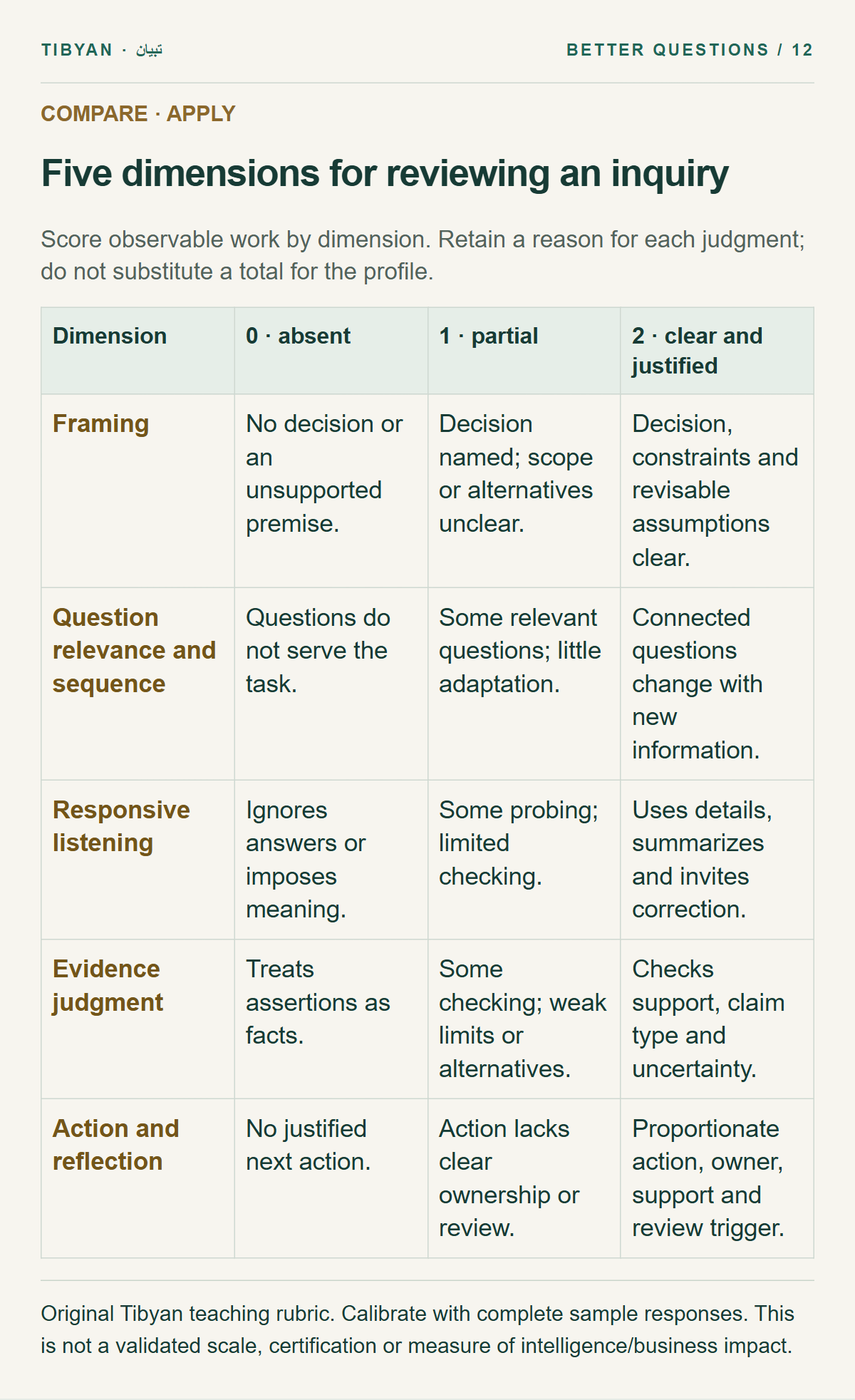
| Dimension | 0 · absent | 1 · partial | 2 · clear and justified |
|---|---|---|---|
| Framing | No clear decision or an unsupported premise. | Decision named; scope or alternatives unclear. | Specific decision, constraints and revisable assumptions. |
| Question relevance and sequence | Questions do not serve the task. | Relevant questions with limited adaptation. | Clear sequence changes with new information. |
| Responsive listening | Ignores answers or imposes an interpretation. | Some probing; limited checking. | Uses details, summarizes accurately and invites correction. |
| Evidence judgment | Treats assertions as facts. | Some checking; weak limits or alternatives. | Checks support, distinguishes claim types and records uncertainty. |
| Action and reflection | No justified next action. | Action proposed; ownership or review incomplete. | Proportionate action, owner, support and review trigger. |
Original evidence-informed teaching aid. Cases and example records are hypothetical; the assessment is not a validated certification.
Workplace follow-up record
After the first suitable, permissioned application opportunity, collect one non-sensitive artifact or observe a conversation. Record task/date, assistance used, the question, the answer or evidence, the revised action, owner, support and next review. Distinguish a learner report from an independently observed artifact. If there is no opportunity, document that rather than inferring failure to transfer. Record business results separately with alternative explanations; a small usability or practice pilot does not establish causal business impact.